
Tire Label Material
Tire label material uses a special high-tack adhesive and durable facestock engineered to bond to rubber and survive the tire curing (vulcanising) process and outdoor storage. It carries barcodes and product data through manufacturing and the supply chain.
Quick answer
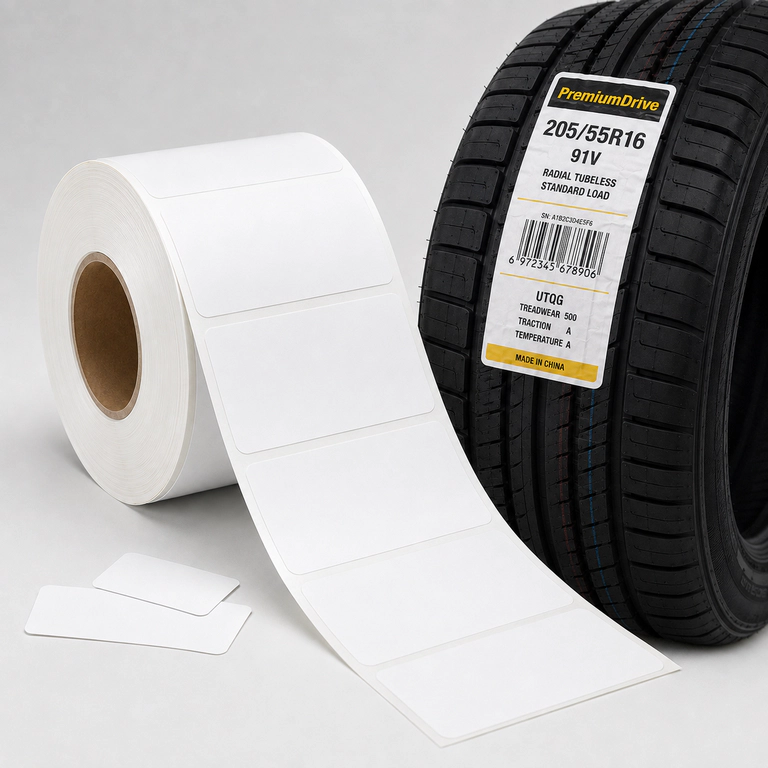
Tire label material is a facestock and special high-tack adhesive construction engineered to bond to low surface-energy rubber and survive the tire curing (vulcanising) process and outdoor yard storage. It carries barcodes for identification through tire manufacturing and the supply chain, typically printed by thermal transfer with a resin ribbon.
Key specifications
| Facestock | Durable film or paper for tire use |
|---|---|
| Adhesive | Special high-tack rubber-bonding |
| Finish | Heat- and abrasion-resistant |
| Adhesive | Permanent acrylic, removable, freezer, high-tack (water-based or hot-melt) |
| Release liner | White glassine, PET, or CCK/kraft |
| Formats | Jumbo roll, log roll, finished slit rolls |
| Max width | Up to 1,600 mm |
| Core sizes | 25 mm (1 in) / 76 mm (3 in) |
| MOQ | From 1 jumbo roll (stock), 3,000–5,000 m² (custom) |
| Certifications | ISO 9001 / ISO 14001 |
Why choose tire label material
Bonds to low-energy rubber
Formulated to grip flexible, low surface-energy rubber where standard adhesives fail.
Survives curing and storage
Holds through vulcanising heat and months of outdoor or yard storage.
Reliable barcode scanning
Keeps codes crisp and scannable across every production and logistics checkpoint.
Abrasion and weather resistant
Resists rubbing, moisture and UV during handling, stacking and transport.
Typical applications
Tire manufacturing & barcoding
Green-tire and finished-tire identification through the production line.
Rubber & automotive parts
Hoses, seals and moulded rubber components needing durable marking.
Learn more →Outdoor-stored goods
Products held in yards and open storage before despatch.
Adhesive & liner options
Tire constructions use specialist high-tack rubber-bonding adhesives on white glassine, PET or CCK/kraft liners; thermal transfer grades with resin ribbons are recommended for barcodes.
Related materials
Buying this material for converting? See jumbo roll and slit roll supply options for tire label stock rolls and match the facestock, adhesive and liner in one specification.
Frequently asked questions
What is tire label material used for?
Tire label material is a purpose-built construction combining a heat-tolerant facestock with a very high-tack adhesive that bonds to low surface-energy, mould-release-contaminated rubber. It is designed to stay attached through the curing (vulcanising) process and the outdoor yard and warehouse storage that follows, keeping barcodes scannable across the whole supply chain.
Tire plants and distributors use it for green-tire identification, cured-tire barcodes, retail marking and warehouse tracking; converters supply it as thermal transfer stock for in-plant printing.
Key factors are curing temperature and dwell, rubber compound and surface condition, whether the label is applied before or after curing, the ribbon used for the barcode image, and required storage life outdoors. Adhesion to a specific compound varies considerably — confirm with sample testing on your own tires.
What is tire label material?
A label stock with a special high-tack adhesive and durable facestock that bonds to rubber and survives tire curing and storage.
Why do tire labels need a special adhesive?
Rubber is a low-energy, flexible surface; a standard adhesive won't hold through the heat of curing and outdoor storage.
Do tire labels survive the vulcanising process?
Yes, they are engineered to keep barcodes scannable through the curing heat and beyond.
Can they be printed with barcodes?
Yes, typically by thermal transfer with a resin ribbon for durability.
What temperature does tire label adhesive need to withstand during curing?
Tire curing (vulcanising) exposes labels to sustained high heat; the high-tack rubber-bonding adhesive used for tire labels is formulated to hold through this process and the outdoor yard storage that follows — exact temperature ratings are confirmed on the datasheet for your specific tire compound and cure cycle.
What liner options are available for tire label material?
Tire label constructions run on white glassine, PET or CCK/kraft liner, matrix-stripped and die-cut to your label shape and roll width, on 25 mm (1 in) or 76 mm (3 in) cores — tell us your applicator so we can confirm liner and release performance.
Can I request a sample of tire label material?
Yes, request a free sample of our rubber-bonding tire label construction, along with the datasheet, so you can test adhesion and barcode scannability through your own curing and handling process before committing to a production order.
What is the minimum order quantity (MOQ)?
Stocked grades start from 1 jumbo roll. Custom constructions or coatings typically start from 3,000–5,000 square meters, depending on complexity.
What adhesive and liner options are available?
Permanent, removable, deep-freeze, high-tack or wash-off adhesive (water-based or hot-melt), on white glassine, PET or CCK/kraft liner — matched to your surface and environment.
Request a free sample of Tire Label Material
Send us your facestock, adhesive, liner and end-use details. We ship free A4 sheets or a trial roll with the technical datasheet, and confirm MOQ, lead time and FOB pricing within one working day.
Get tire label material, built to your spec.
Tell us your facestock, adhesive, liner and roll requirements — we quote within one business day. Free samples available.