
PE Film Label Material
PE film label material uses a polyethylene facestock in a pressure-sensitive laminate. It is often evaluated for squeeze tubes and flexible bottles because the face can follow container movement. Select the face, adhesive and release liner together, then test the printed label on the filled pack.
Download PE Film TDS (PDF) ↓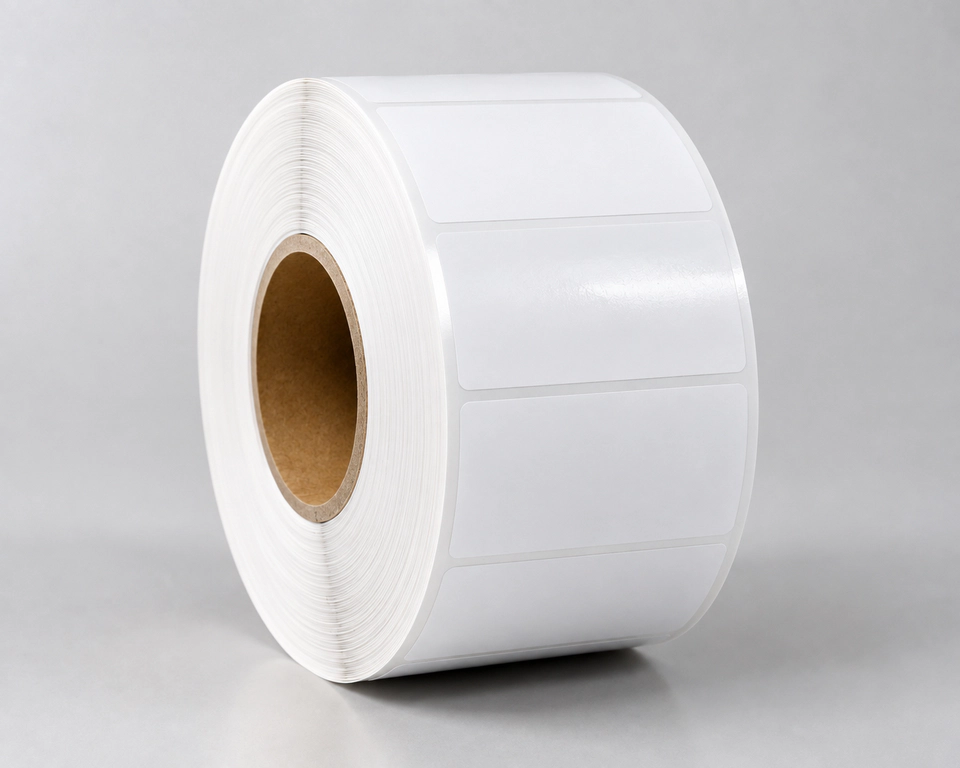
Key specifications
| Facestock | PE (polyethylene) film, white or clear |
|---|---|
| Face thickness | 85–100 µm |
| Finish | Soft, conformable, gloss or matte |
| Adhesive | Permanent acrylic, removable, freezer, high-tack (water-based or hot-melt) |
| Release liner | White glassine, PET, or CCK/kraft |
| Formats | Jumbo roll, log roll, finished slit rolls |
| Max width | Up to 1,600 mm |
| Core sizes | 25 mm (1 in) / 76 mm (3 in) |
| MOQ | From 1 jumbo roll (stock), 3,000–5,000 m² (custom) |
| Certifications | ISO 9001 / ISO 14001 |
What is PE film label material?
PE is the label face, not the adhesive or the container. In self-adhesive label stock, that face is combined with a pressure-sensitive adhesive and a release liner.
The material is considered where packaging changes shape during use. Softness alone does not establish whether a label will stay attached, keep its appearance or dispense correctly. The grade, print, adhesive, label shape and container all matter.
For application-specific checks, use the squeezable container guide. This product page focuses on specifying the material and roll for a trial.
Specify the pack, not only the polymer
A rigid HDPE bottle and a repeatedly squeezed HDPE bottle do not present the same labeling requirement. Describe the movement, label area and conditions instead of selecting a material solely because both the bottle and label contain polyethylene.
| Packaging detail | What to provide | What to review in the trial |
|---|---|---|
| Container | Material, shape, surface condition and a representative filled pack | Bond and fit on the real labeled area |
| Movement | Where and how the pack is squeezed or flexed | Creasing, edge lift, print damage and appearance after use |
| Label geometry | Width, height, corners, coverage and any cuts or perforations | Behavior at edges, curves and cut features |
| Use conditions | Moisture, product contact, cleaning, storage and application conditions | The printed label and adhesive under the intended exposure |
| Application line | Manual or automatic application, dispensing arrangement and roll requirements | Release, positioning and handling of the chosen construction |
These are trial-planning checks, not published performance results. Agree the relevant conditions and acceptance criteria for the job.
White or clear PE?
A white face provides a light background for graphics. Review the actual opacity on the filled pack; the material name alone is not an opacity specification.
A clear face leaves more of the container visible. Check its appearance together with the adhesive, artwork and container surface rather than assuming it will match another clear film.
Ask which grade and finish are available for the requested construction. White and clear descriptions do not establish identical print compatibility or handling.
Select the adhesive and release liner together
Specify whether the container is PE, HDPE, PP or another material, whether its surface is treated, and whether it is clean and dry at application. Include the temperature at labeling separately from later storage or service conditions.
Request a bond appropriate to the job, including removal if required. Strong initial tack is not, by itself, evidence of long-term attachment.
The liner must also suit the label shape, die-cutting, waste removal and dispensing process. A PET or glassine description is not a complete converting specification, and every face should not be assumed available with every adhesive and liner.
Use the adhesive and liner selection guide to prepare the component request.
Printing and converting a conformable film
Confirm the selected grade against the press and ink system. For digital work, identify the printer and distinguish UV inkjet from water-based inkjet. Do not treat all printable PE grades as interchangeable.
Include the full print and finishing sequence in a trial: inks, drying or curing, varnish or laminate, die-cutting, matrix stripping and application. Inspect the printed label after the package is used as intended, not only as it leaves the press.
If ink is coming away from the face, follow the film ink-adhesion checks. If converting fails during waste removal, use the matrix-stripping troubleshooting guide. Do not change material without separating print, tooling and application causes.
Compare PE with BOPP or PET
| Decision | Starting point |
|---|---|
| The container flexes repeatedly | Evaluate a conformable face with the actual print, adhesive and label geometry |
| The package is rigid and transparent appearance is central | Compare clear BOPP on the same pack |
| The requirement is an opaque packaging label | Compare white BOPP and the proposed white PE grade |
| The label has a different industrial durability requirement | Review the specific PET film construction rather than choosing by polymer name alone |
For a paper-like face comparison, see PP synthetic paper vs PE film. Neither softness nor a material-family description replaces a trial.
Request PE film label stock for a trial
Send the container and movement requirement, label dimensions, print method and exposure conditions. Add the roll width, length, core, maximum outer diameter, winding direction and expected order quantity.
A swatch can help with initial appearance and hand-application checks. A converting trial needs material in a format that fits the equipment. Confirm sample scope, availability, charges, freight, MOQ and lead time for the proposed construction.
For production-roll planning, see jumbo and slit roll supply requirements. For surface-specific selection, use the HDPE and PP container guide.
Related materials
Frequently asked questions
Is PE film the same as PET film?
No. PE is polyethylene; PET is polyester. They are different facestock families. Choose a specific construction for the container, printing process and use conditions rather than treating the names as interchangeable.
Does PE prevent creasing or edge lift after every squeeze?
No. A conformable face is one part of the construction. Print and adhesive selection, container movement, label geometry and application also need assessment on a representative filled pack.
Does a water-resistant face make the printed label waterproof?
Not by itself. The image, protective finish, adhesive and container bond must suit the exposure. Include the intended wet conditions in the trial.
Is high elongation enough for a bottle-strap label?
No. Elongation is not a load rating or proof that cut features and anchor areas will hold. Treat the strap as a separate application requiring its own design and validation. Use the wearable bottle-label application guide; do not approve a carrying function from a generic PE data sheet.
Request PE film samples or a quote
Send the container, movement, print method, exposure and roll requirements so the sample and quotation match the actual trial.