
Application guide
Label Materials for Squeezable Containers
Choose a pressure-sensitive label construction for squeeze tubes, soft bottles and semi-squeezable packaging. Match the facestock, adhesive, release liner and label geometry to the container's deformation, surface, product exposure and converting line before ordering rolls.
Quick answer: what label material works on a squeezable container?
PE film is a practical starting point for a fully squeezable tube or soft bottle because it is more conformable than a rigid film. A semi-squeezable bottle may use PE or another documented conformable film. The correct choice also depends on label size, container shape, adhesive wet-out, print construction and how the filled pack behaves through repeated squeeze and recovery.
- Use container movement, not the product category alone, to choose the facestock.
- Start with PE film for full-squeeze tubes and thin-wall bottles.
- For semi-squeeze bottles, compare a qualified conformable film with PE rather than assuming standard BOPP will recover cleanly.
- Match the adhesive to the actual container resin, treatment and application conditions.
- Test the printed and converted label on filled production containers through repeated squeeze and recovery.
Classify the container by how it moves
Two bottles made from the same resin can place different stress on a label. Wall thickness, bottle size, shoulder shape, grip panels, fill volume and the way a user dispenses the product all affect deformation. Begin with the filled package, not only the resin code.
Use three working categories:
Rigid container
The label panel changes little during normal use. Standard BOPP, paper or PET may be suitable depending on the surface and exposure. Continue to the material page for the actual container, such as Label Materials for HDPE and PP Containers or Label Materials for PET Bottles.
Semi-squeezable container
The wall flexes, but the package retains most of its shape. A lower-rigidity, documented conformable film may provide better recovery than standard BOPP while retaining enough stiffness for converting and dispensing. AllinLabel availability must be confirmed before naming an MDO or polyolefin construction.
Fully squeezable container
The tube or bottle deforms substantially and repeatedly during use. PE film is a practical first sample because it can follow complex movement better than a stiff face. The complete laminate still needs to recover without permanent creasing, edge lift, tunneling or unacceptable print distortion.
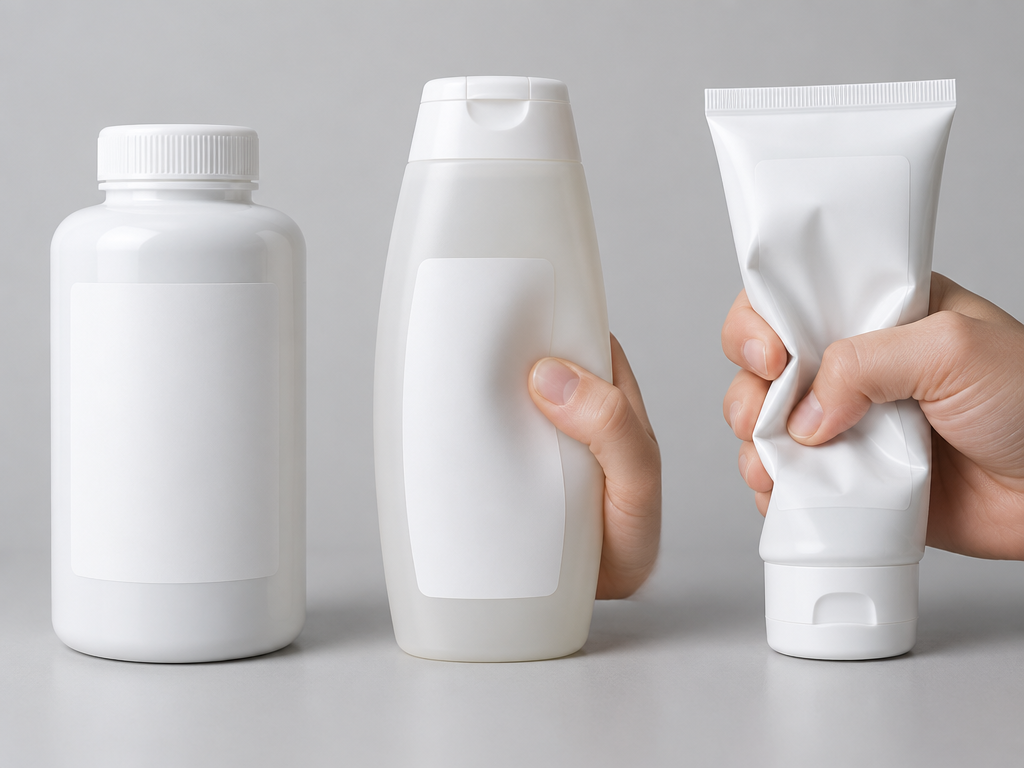
Starting constructions by squeeze level
| Container and use | Facestock starting point | Adhesive requirement | What to validate |
|---|---|---|---|
| Cosmetic or personal-care squeeze tube | White or clear PE film | Permanent adhesive validated on the exact tube surface and seam area | Repeated squeeze, shoulder and crimp clearance, oil or surfactant exposure, print recovery |
| Thin-wall condiment or sauce bottle | PE film; documented conformable film may suit limited deformation | Permanent adhesive matched to the bottle resin and filling conditions | Filled-pack flexing, refrigeration, oil or sauce at the label edge, abrasion and food-packaging documentation |
| Semi-squeezable shampoo or lotion bottle | PE or a qualified semi-squeeze film | Adhesive that maintains contact as the wall flexes and recovers | Darts, wrinkles, label movement, bathroom humidity and product leakage |
| Soft household-product bottle | White or clear PE film, subject to named chemical exposure | Adhesive and print construction tested against the actual formulation | Cleaner or oil splash, repeated grip deformation, scuffing and text readability |
| Clear soft bottle requiring a no-label look | Clear PE or another confirmed conformable clear film | Clear adhesive with acceptable wet-out on the actual surface | Haze, bubbles, stretch marks, edge visibility and white-ink appearance |
| Small-radius or contoured squeeze pack | PE film with label dimensions kept inside the workable panel | Adhesive selected for the exact resin, curvature and application pressure | Edge flagging, bridging, shoulder stress, dispensing and die-cut accuracy |
This table defines a first trial, not a guaranteed specification. Confirm the available facestock, adhesive, liner and print surface against current AllinLabel documentation before quoting the construction.
Why standard rigid films can fail after squeezing
A label can apply smoothly and still fail when the filled container is used. If the facestock resists the container’s movement, stress concentrates at the corners, edges, shoulders or the deepest part of the deformation.
Common results include:
- wrinkles or darts that remain after the bottle recovers;
- edge lift where the label crosses a tight radius or tapered panel;
- tunneling or bubbles as the face and container recover at different rates;
- cracked ink, varnish or foil on the squeeze line;
- distorted text or barcodes;
- adhesive movement or ooze when the construction is repeatedly stressed;
- a label that springs away from the pack even though initial adhesion looked acceptable.
A stronger adhesive alone does not make a rigid facestock conformable. First check the deformation, facestock stiffness, label area and geometry, then evaluate the adhesive.
PE film is the main full-squeeze starting point
PE film is softer and more conformable than standard rigid BOPP or PET films. It can move with tubes and thin-wall bottles, making it a useful first sample for cosmetics, personal care, food and household squeeze packs.
Do not select PE only from the polymer name. Film thickness, modulus, orientation, surface treatment and topcoat affect printing, die-cutting, dispensing and recovery. Clear and white versions also present different appearance requirements. Confirm the exact PE construction and TDS before setting press conditions or making performance claims.
Related product: PE Film Label Material. For stiffer rigid-pack alternatives, compare white BOPP label material and clear BOPP label material.
Semi-squeeze packaging needs a balance of stiffness and conformability
A semi-squeezable bottle does not always need the softest available film. The label still needs enough stiffness for die-cutting, matrix stripping and automatic dispensing. The correct balance depends on bottle size, label coverage and the amount of deformation.
Industry suppliers use terms such as semi-squeeze film, MDO film and conformable polyolefin, but these names cover product-specific constructions. Do not add them to an AllinLabel quotation until current supply and technical data are confirmed. Where no documented semi-squeeze construction is available, compare PE film with the current BOPP option on the filled production bottle.
Useful background: PP synthetic paper vs PE film and BOPP vs PET label material.
Match the adhesive to both the surface and the movement
Squeeze bottles and tubes are often made from low-surface-energy plastics. Resin, pigments, recycled content, slip additives, mould-release residue, surface treatment and product contamination can change adhesive wet-out.
The adhesive must first build contact with the container and then maintain that contact as the wall flexes. Record the application temperature separately from the service temperature. Also record whether the container is empty or filled during labelling, because filling can change the label panel and surface condition.
Do not specify only “permanent,” “high tack” or “acrylic.” Those are starting descriptions, not complete evidence. Compare current adhesive data, then test the selected coat weight, facestock and liner as one laminate.
Related guide: Label Adhesives and Release Liners. Surface-energy, contamination and resin selection for rigid polyolefin packs stays on label materials for HDPE and PP containers.
Label size and shape can matter as much as the material
A conformable film cannot correct a label that bridges a shoulder, crosses a deep grip panel or extends beyond the workable label area. Larger labels on more complex shapes generally experience more deformation and need greater conformability.
Before die-cutting production rolls:
- 1Map the flattest workable panel on the filled container.
- 2Measure the smallest and largest diameter across the label area.
- 3Keep the label clear of the cap, shoulder, bottom radius, tube crimp and major moulding seams.
- 4Use rounded corners where they reduce local edge stress.
- 5Trial more than one label size if the first design covers a large share of the flexible wall.
- 6Check whether front and back labels behave better than one large wrap label.
Approve the label shape on the real pack. A drawing or flat artwork cannot reproduce the wall movement.
Printing, converting and dispensing still need control
Soft films can stretch or distort if web tension, heat or nip pressure is unsuitable. Ink, white ink, varnish, laminate and foil can also change the stiffness of the printed label. A facestock that is conformable before printing may behave differently after the full print build is added.
Confirm:
- the surface treatment or topcoat for the intended print process;
- ink cure and heat exposure on press;
- web tension through printing and finishing;
- die-cut depth and matrix-stripping behavior;
- label pitch, corner radius and dispensing speed;
- liner release and dimensional stability;
- sensor performance with clear film and clear liner combinations;
- winding direction, core and finished roll diameter.
PET liner may provide dimensional stability for demanding die-cutting or dispensing, while glassine may suit other converting requirements. Neither liner is automatically best. Test the complete construction on the intended equipment.
Test the filled pack through squeeze and recovery
The useful trial reproduces converting, application, filling and consumer handling. Set the number and severity of squeeze cycles from the customer’s product-use scenario. Do not publish an arbitrary universal cycle count.
- 1Collect production containers from normal batches and record the resin, wall thickness or pack specification if available.
- 2Compare the empty and filled container to identify how filling changes the label panel.
- 3Apply converted labels with the intended equipment, pressure, speed and container surface temperature.
- 4Allow the agreed dwell time before starting the deformation test.
- 5Squeeze the filled pack at the actual grip area and dispensing orientation.
- 6Let the container recover for the defined interval, then inspect the label before the next cycle.
- 7Repeat the customer-defined sequence under the required room, chilled, humid or wet conditions.
- 8Inspect wrinkles, darts, tunnels, edge lift, adhesive movement, print cracking, haze and barcode readability.
- 9Repeat after exposure to the actual product, oil, surfactant, cleaner or other named substance where relevant.
- 10Keep the container lot, label roll, print build, application settings, dwell time, squeeze sequence and acceptance criteria with the result.
Change one variable at a time. A test that changes the facestock, adhesive, label size and line settings together cannot show which change solved the problem.
Request Squeezable Container Material Samples
Common squeeze-label failures and next checks
| Symptom | First checks | Next controlled trial |
|---|---|---|
| Permanent wrinkles after the first squeeze | Facestock stiffness, label coverage, filled-pack deformation | Compare a more conformable film or reduce the label area |
| Corners or edges lift | Tight radius, shoulder overlap, corner shape, adhesive wet-out | Move the edge onto the workable panel, increase corner radius, then compare adhesive if needed |
| Label tunnels or bubbles after recovery | Different recovery of label and container, trapped air, oversized label | Reduce coverage and compare the current face with a qualified conformable option |
| Ink or varnish cracks | Print build is stiffer than the unprinted facestock, cure settings, squeeze line | Test the complete printed label and adjust ink, coating or construction |
| Clear label turns hazy or shows stress | Adhesive wet-out, film deformation, surface texture, white ink | Test clear PE or another documented conformable clear construction on production packs |
| Label dispenses poorly | Facestock too soft for current die-cut/liner/release setup, web tension | Trial the complete facestock-liner combination and adjust converting settings |
| Label lifts only after product use | Oil, surfactant, cleaner or contents reaching the edge | Run exposure testing with the actual product and inspect adhesive anchorage |
If the label fails before the pack is squeezed, continue to the pressure-sensitive label peel-off troubleshooting guide. That page separates contamination, temperature, application pressure and adhesive causes from deformation problems.
Recycling compatibility follows the container stream
Do not call a squeezable label recyclable only because the label and container use related polymers. Compatibility depends on the container, facestock, adhesive, ink, decoration, label coverage and the current rules and test protocol for the destination recycling stream.
Identify whether the package is HDPE, LDPE, PP, a multilayer tube or another structure. Use the current guideline for that exact package. Do not transfer a PET bottle result to a squeezable HDPE bottle, and do not describe an untested AllinLabel construction as approved or certified.
What to send with a squeezable-container enquiry
Send enough information for the first sample set to answer a real question:
- product category and actual container resin or multilayer structure;
- rigid, semi-squeezable or fully squeezable behavior;
- empty and filled production containers, or clear videos of the squeeze and recovery;
- bottle or tube drawing, label panel, shoulder, seam, crimp and grip area;
- label dimensions, shape, corner radius and percentage of wall coverage;
- white, clear, metallic or other appearance;
- print process, ink, white ink, varnish, laminate or foil;
- application temperature and service temperature;
- whether labels are applied before or after filling;
- exposure to water, humidity, oil, surfactants, food, cleaners, chemicals or abrasion;
- intended squeeze sequence and acceptance criteria;
- roll width, core, winding direction, liner, applicator and line speed;
- expected order format, sample format and annual volume;
- destination market and any named recycling or compliance protocol.
For converter-ready supply, review Label Stock Jumbo Rolls before sending the roll specification. Industry context sits on cosmetics and personal care label material, food and beverage label material and chemical and industrial label material.
Frequently asked questions
- What is the best label material for a squeezable bottle?
- PE film is a practical starting point for a fully squeezable bottle because it is more conformable than standard rigid films. A semi-squeezable bottle may use PE or another documented conformable film. Final selection depends on the bottle shape, label size, resin, adhesive, print build and repeated-squeeze trial.
- Is BOPP suitable for squeeze bottles?
- Standard BOPP can suit rigid or lightly flexing bottles, but it may wrinkle, dart or lift on a pack that deforms substantially. Do not classify the bottle only by resin. Compare the printed BOPP construction with a more conformable option on the filled production container.
- Why is PE film used for squeeze tubes?
- PE film is softer and more conformable than rigid PP or PET films, so it can follow a flexible tube through squeezing and recovery. The exact PE thickness, adhesive, liner and print construction still determine converting, dispensing and in-use performance.
- What is the difference between semi-squeeze and full-squeeze packaging?
- A semi-squeeze package flexes but retains most of its shape. A full-squeeze package deforms substantially and repeatedly during dispensing. The distinction is practical, not a universal material standard, so define the test from the actual filled pack and use conditions.
- Can a stronger adhesive fix wrinkles on a squeeze bottle?
- Not by itself. Wrinkles and darts often indicate that the facestock or label geometry cannot follow the container. Check film stiffness, label area, curves and squeeze pattern before increasing tack. The adhesive must match the surface, but it cannot make a rigid face flexible.
- Should squeeze testing use an empty or filled container?
- Use the filled production package whenever possible. Filling can change wall tension, surface condition, deformation and recovery. Keep empty-container observations as a comparison, not as the only qualification test.
- What sample should a converter request?
- Request the proposed facestock, adhesive and liner in a roll format close to the intended print, die-cut and dispensing setup. Include production containers and the full print build so the trial evaluates the same stiffness and deformation expected in production.
Match the construction to the way the pack moves
Send the filled container, label geometry, print build, exposure and roll requirements. AllinLabel can propose a starting construction for converting and repeated-squeeze trials. Final suitability remains subject to testing on the actual package and application line.
Request a quote or a free sample
Send us your facestock, adhesive, liner and roll specification. Low MOQ, OEM/ODM, export to 60+ countries.