
Application guide
Label Materials for Glass Bottles and Jars
Choose a pressure-sensitive label construction for food jars, beverage bottles, cosmetic glass and reusable containers. Match the facestock, adhesive and release liner to moisture, temperature, appearance, filling conditions and the package's end-of-life route before ordering converter-ready rolls.
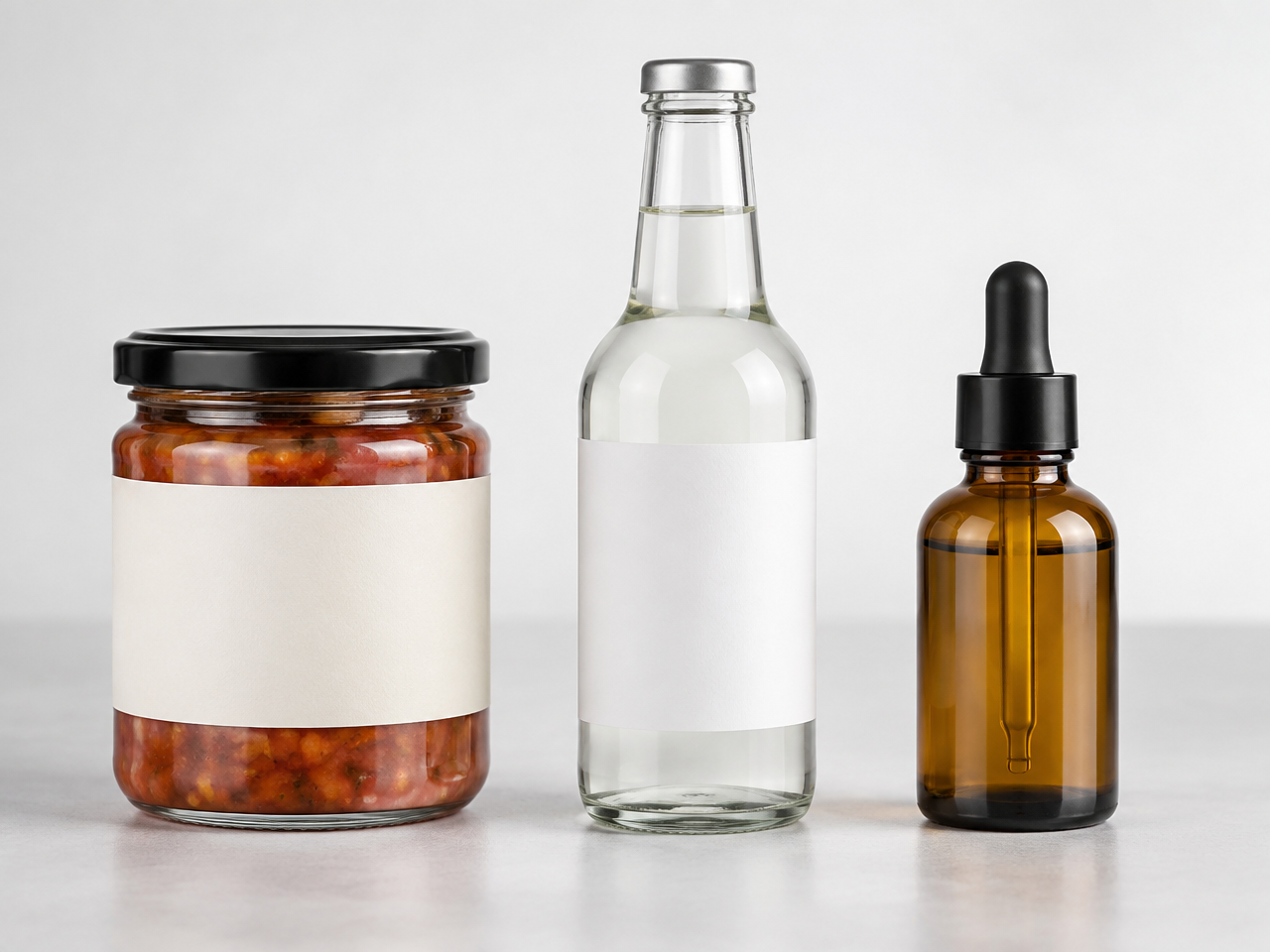
Quick answer: what label material works on glass bottles and jars?
For dry, single-use glass packaging, coated paper or BOPP with a permanent adhesive is a practical starting point. Use clear BOPP with a clear adhesive for a no-label look, and white BOPP where moisture resistance and opacity matter. PET can suit applications that need greater heat, chemical or abrasion resistance. Reusable glass needs a wash-off construction validated in the actual bottle-washing process.
- Start with coated paper for dry food jars and products that need a paper appearance.
- Start with clear BOPP for transparent, no-label-look decoration on smooth glass.
- Use white or metallized BOPP when the label needs opacity, moisture resistance or a metallic effect.
- Consider PET when durability is more important than conformability or material cost.
- Do not apply a standard pressure-sensitive label over condensation unless the construction is specifically validated for wet application.
- Treat single-use glass recycling and returnable-bottle washing as different requirements.
Define the package before choosing the label
Glass generally provides a receptive surface for pressure-sensitive adhesives, but the production container is not a perfect laboratory panel. Dust, oil, release residue, surface treatments, recycled-glass variation, embossing, seams and compound curves can change label contact. Condensation can prevent the adhesive from reaching the glass at all.
Record these conditions before requesting samples:
- 1Container type: bottle or jar, clear or colored glass, smooth or embossed.
- 2Label panel: diameter, taper, seam, shoulder, recess and available flat area.
- 3Labelling point: before or after filling, and whether the glass is dry, warm, chilled or wet.
- 4Service exposure: refrigeration, condensation, ice water, oil, product splash, cleaning chemicals, abrasion or sunlight.
- 5Appearance: paper, opaque white, metallic or clear no-label look.
- 6End-of-life route: single-use recycling, refill, returnable bottle pool or another defined system.
- 7Converting details: print process, varnish or laminate, die-cut shape, dispensing speed, roll direction and core size.
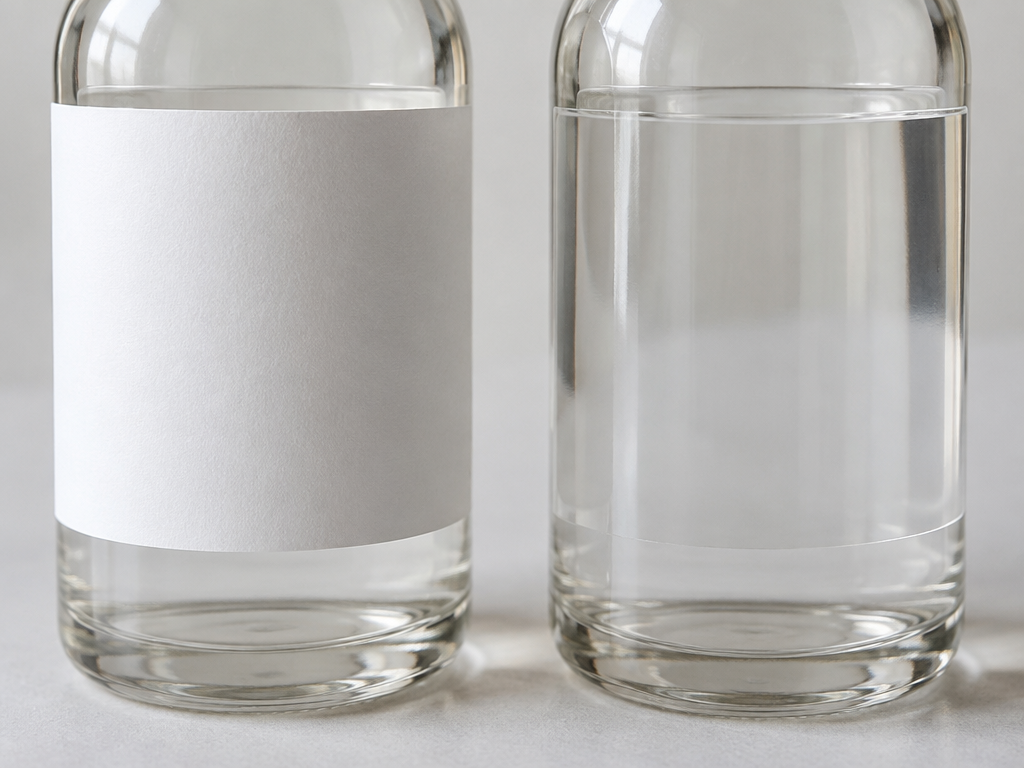
Starting constructions by glass application
| Glass package and use | Facestock starting point | Adhesive requirement | What to validate |
|---|---|---|---|
| Dry-shelf food jar for honey, sauces, spices or preserves | Semi-gloss or cast-coated paper; white BOPP when handling moisture is expected | Permanent adhesive suitable for clean, dry glass | Label-panel fit, varnish or laminate, oil or product splash, storage humidity |
| Refrigerated food jar or chilled beverage bottle | White or clear BOPP; a documented wet-strength paper construction where available | Moisture-resistant adhesive matched to the real application temperature | Condensation timing, edge lift, label movement, whitening and print durability |
| Clear bottle or jar requiring a no-label look | Clear BOPP; clear PET where higher durability is required | Clear adhesive with even wet-out on the actual glass | Haze, bubbles, dust, glass seams, label edge visibility and white-ink appearance |
| Cosmetic serum, fragrance or skincare glass | Clear, white or metallized BOPP; premium paper for dry-use formats | Permanent adhesive selected for oils, alcohols or product contact at the label edge | Product splash, bathroom humidity, cap leakage, scuffing and shelf appearance |
| Household or specialty product in glass | White BOPP or PET, depending on the named exposure | Adhesive selected against the actual cleaner, oil or chemical | Chemical resistance, abrasion, outdoor exposure and barcode readability |
| Returnable or refillable glass bottle | Paper or film wash-off construction supported by current documentation | Wash-off adhesive matched to the customer's bottle-washing process | In-use adhesion, removal time, adhesive residue, label and ink behavior, washer contamination |
This table narrows the first sample set. It is not a product specification or evidence that one construction is suitable for every bottle, jar, filling line or recovery system.
Choose paper when the pack stays reasonably dry
Paper provides a familiar printed surface and can support natural, craft or high-gloss presentation. Semi-gloss paper is a practical starting point for general food jars and dry-shelf products. Cast-coated paper provides a smoother, glossier face where print appearance is the priority.
Paper is more sensitive to water, humidity and edge exposure than film. A varnish or laminate can protect the printed surface, but it does not automatically make the full label construction suitable for condensation, ice water or washing. If a paper look is required in a wet application, ask for a documented wet-strength facestock and test the printed, converted label.
Related materials: semi-gloss label paper and high-gloss cast-coated label paper.
Use clear BOPP for a no-label look
Clear BOPP lets the glass and product remain visible around the printed graphics. The result depends on the whole construction. The adhesive must wet out evenly, the glass must be clean, and the print design may need white ink so text and colors do not disappear against the product.
Check the production bottle or jar under the lighting used for pack approval. Glass seams, embossing, dust, trapped air and condensation can remain visible beneath a transparent label. A clear film that looks good on a flat glass panel can still show haze or edge stress on a tapered container.
Related material: clear BOPP label material.
Use white or metallized BOPP for opacity and moisture resistance
White BOPP hides the fill color and provides an opaque print surface while resisting water better than ordinary paper. It is a useful starting point for chilled foods, beverages, cosmetics and household products in glass.
Silver metallized BOPP adds a metallic appearance without relying on a fully opaque printed paper face. Confirm ink coverage, white backing, varnish and scuff resistance with the converter because the final visual result depends on the print build as well as the facestock.
Related materials: white BOPP label material and silver metallized BOPP label material.
Consider PET for demanding exposure
PET film is dimensionally stable and can be a useful starting point when the label must tolerate greater abrasion, heat or named chemicals. It is stiffer than many BOPP or PE constructions, so small diameters, shoulders and compound curves need extra attention. Do not specify PET only because the container is glass; specify it because the service conditions justify the additional durability.
Related material: PET label material.
Match the adhesive to application and service conditions
The phrase “for glass” is not a complete adhesive specification. Select the adhesive around the conditions when the label is applied and the conditions it faces after application.
For clean, dry glass at normal line conditions, a permanent acrylic construction is a common starting point. A chilled bottle can present a different problem: if condensation forms before labelling, the adhesive may contact water instead of glass. In that case, either control the line so the label panel is dry or test a construction documented for the actual wet-application condition.
- Application temperature is the temperature of the container and environment when the label is applied.
- Service temperature is the range the bonded label experiences later.
- Moisture resistance describes performance after application; it does not prove that a label can be applied through standing water or condensation.
- Wash-off describes controlled removal in a defined process; it is not another name for a weak or removable adhesive.
Use the acrylic vs hotmelt label adhesive comparison as background, then confirm the selected construction with current AllinLabel technical data and a production-container trial.
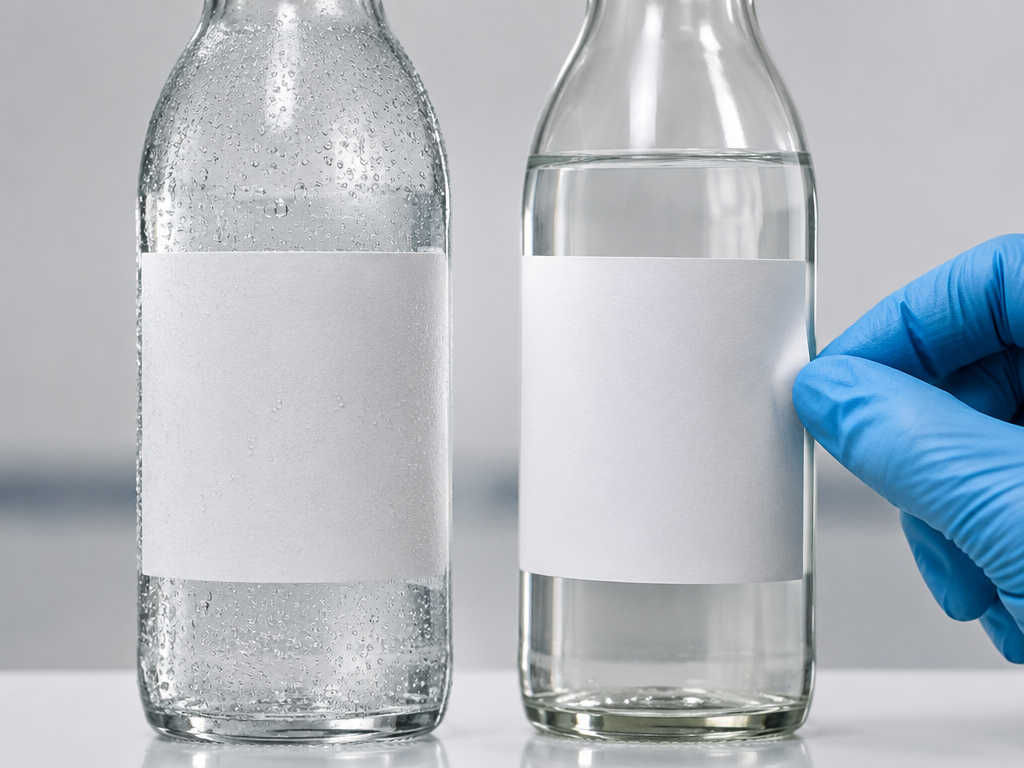
Do not ignore the release liner
The liner affects die-cutting, matrix stripping, roll stability, label release and automatic dispensing. Glassine is common for general converting. PET liner can provide a thin, dimensionally stable carrier for small labels, clear labels or demanding dispensing. A heavier paper liner may suit other converting formats.
Choose the liner after confirming label size, die-cut geometry, applicator sensor, line speed, roll width, core and winding direction. The container is glass, but the liner still has to work on the converter's and packer's equipment.
Related guide: label adhesives and release liners.
Common glass-label failures and what to check
| Symptom | Likely checks | Corrective direction |
|---|---|---|
| Label slides or lifts soon after application | Condensation, cold glass, low wipe-down pressure, contamination | Dry the label panel or trial a construction documented for the real application condition |
| Clear label looks cloudy | Uneven adhesive wet-out, moisture, dust, surface marks, unsuitable clear adhesive | Test a clear adhesive and liner combination on production glass under inspection lighting |
| Edges lift on a bottle shoulder or tapered jar | Label extends beyond the flat panel, facestock is too stiff, corner radius is too small | Reduce label area, increase corner radius or trial a more suitable facestock |
| Paper wrinkles or loses opacity when chilled | Paper absorbs moisture, edge is unprotected, coating or overprint protection is insufficient | Trial protected or wet-strength paper, or move to a film construction |
| Label scuffs or ink transfers | Print system, ink cure, varnish or laminate does not match handling | Test the printed and finished label through filling, packing and transport |
| Reusable bottle retains label or adhesive | Wash-off construction does not match washer conditions, ageing or print build | Test the complete aged label in the customer's actual washing protocol |
If labels are already peeling, use the pressure-sensitive label peel-off troubleshooting guide to separate surface preparation, geometry, application and material causes.
Test the complete label on production glass
A useful test reproduces the actual bottle or jar, printed label, line settings and service conditions. Do not approve a glass construction only from a hand-applied label on a clean flat panel.
- 1Collect production containers from more than one normal glass batch.
- 2Record color, surface treatment, embossing, seam, taper and any cleaning process.
- 3Confirm whether labels are applied before or after filling and measure the container surface condition at application.
- 4Apply converted labels with the intended applicator, line speed and wipe-down pressure.
- 5Inspect initial wet-out, bubbles, wrinkles, edge contact and label position.
- 6Recheck after the agreed dwell period and after filling, capping, packing and transport simulation.
- 7Condition samples through the real refrigeration, condensation, water, oil, product splash, abrasion, heat or sunlight exposure.
- 8Record edge lift, label movement, haze, whitening, adhesive residue, print damage and barcode readability.
- 9For reusable glass, test aged printed labels in the customer's named bottle-washing process and record both removal and in-use performance.
Change one variable at a time and keep the container batch, label roll, application settings, conditioning time and acceptance criteria with the result.
Request Glass Container Material SamplesSingle-use glass recycling is not the same as glass reuse
Single-use glass is collected, processed as cullet and remelted. Returnable glass is washed and refilled as the same container. Those routes impose different label requirements.
For a single-use package, begin with the current design-for-recycling guidance in the destination market and confirm how label facestock, adhesive, ink, decoration and coverage are handled. For a returnable bottle pool, the label must remain secure through distribution and consumer use, then release under the defined industrial washing conditions without unacceptable residue or washer contamination.
Do not copy a wash temperature, alkali concentration or dwell time from another supplier's datasheet. Ask the customer for the actual protocol, then verify the complete printed label. Continue to how to test wash-off labels for PET, HDPE and glass packaging for the test workflow and to wash-off adhesive label material for available starting constructions.
For wine and spirits packaging, including wet-strength textured papers, ice-bucket performance and decoration, continue to wine and spirits label material. For jars and bottles in retail food ranges, see food and beverage label material and cosmetics and personal care label material.
What to send with a glass-container material enquiry
Send enough detail for the first sample to test a real risk:
- bottle or jar use: food, beverage, cosmetics, household or another named product;
- clear or colored glass and a production container or dimensioned drawing;
- photos of the label panel, seams, embossing, shoulders and taper;
- label size, shape and corner radius;
- paper, white, clear or metallic appearance;
- print process, ink system, white ink, varnish or laminate;
- whether labelling occurs before or after filling;
- container surface temperature and whether the label panel is dry or wet at application;
- refrigeration, condensation, ice water, oil, chemical, abrasion, heat or outdoor exposure;
- permanent, removable or wash-off requirement;
- for reusable glass, the named wash process and acceptance criteria;
- roll width, core, winding direction, liner and applicator details;
- sample format, expected order format and annual volume;
- destination market and any required recycling or compliance protocol.
For converter-ready supply, review label stock jumbo rolls before sending the roll specification.
Frequently asked questions
- What is the best label material for a glass bottle?
- There is no single best material for every glass bottle. Clear BOPP is a practical starting point for a no-label look, white BOPP for opaque moisture-resistant decoration, coated paper for dry applications and PET for more demanding durability. The adhesive and finished label must be tested on the actual bottle and filling line.
- Are paper labels suitable for glass jars?
- Yes, coated paper can suit dry-shelf food jars and products that need a paper appearance. If the jar is refrigerated, exposed to condensation or handled with water or oil, test the printed paper, protective finish and adhesive together. Ordinary paper should not be assumed to be wash-resistant.
- Why does a label peel off a glass bottle?
- Common causes include condensation during application, oil or dust on the glass, insufficient application pressure, a label extending onto a shoulder or taper, a stiff facestock on a tight curve, and an adhesive that does not match the temperature or exposure. Inspect the process before changing only the adhesive.
- Can clear BOPP create a no-label look on glass?
- Yes. Clear BOPP with a clear adhesive can make graphics appear to sit directly on smooth glass. Approve it on production containers because adhesive wet-out, dust, bubbles, seams, embossing and white-ink coverage affect the final clarity.
- Can a standard label be applied to a wet or condensing bottle?
- Do not assume so. Water between the adhesive and glass can prevent contact and cause the label to slide or lift. Keep the label panel dry at application or trial a complete construction specifically documented for the actual wet-application condition.
- Do all glass bottles need a wash-off adhesive?
- No. A wash-off construction is mainly relevant when a defined recycling or reusable-bottle process requires controlled label separation. Single-use glass and returnable glass follow different processes, so confirm the destination system before specifying the adhesive.
- What should a converter request as a sample?
- Request the proposed facestock, adhesive and liner in a roll format close to the intended print, die-cutting and dispensing conditions. Supply production bottles or jars and record whether the surface is dry, chilled or wet when the label is applied.
Specify the glass package, then test the construction
Send the container, label geometry, appearance, printing method, application condition, service exposure and roll requirements. AllinLabel can propose a starting material construction for converting and application trials. Final suitability remains subject to testing on the actual glass package and line.
Request a quote or a free sample
Send us your facestock, adhesive, liner and roll specification. Low MOQ, OEM/ODM, export to 60+ countries.