
Material comparison
Acrylic vs Hotmelt Label Adhesive: Which Should You Choose?
Use this guide to compare acrylic and hotmelt pressure-sensitive label adhesives before choosing material for bottles, cartons, films, cold-chain labels, industrial packaging or difficult surfaces. The right adhesive depends on initial tack, final bond, surface energy, temperature, facestock, liner, converting format and sample testing.
Quick answer
Acrylic adhesive is usually the better starting point for smooth packaging surfaces, clear film labels, long shelf life, UV exposure and cleaner aging. Hotmelt adhesive is usually the better starting point when labels need stronger initial tack on rough cartons, recycled board, textured surfaces, low-energy plastics or difficult substrates. Neither adhesive should be approved without testing on the actual container and service condition.
Acrylic and hotmelt can both be permanent adhesive systems. This page compares adhesive chemistry and performance behavior, not permanent vs removable use.
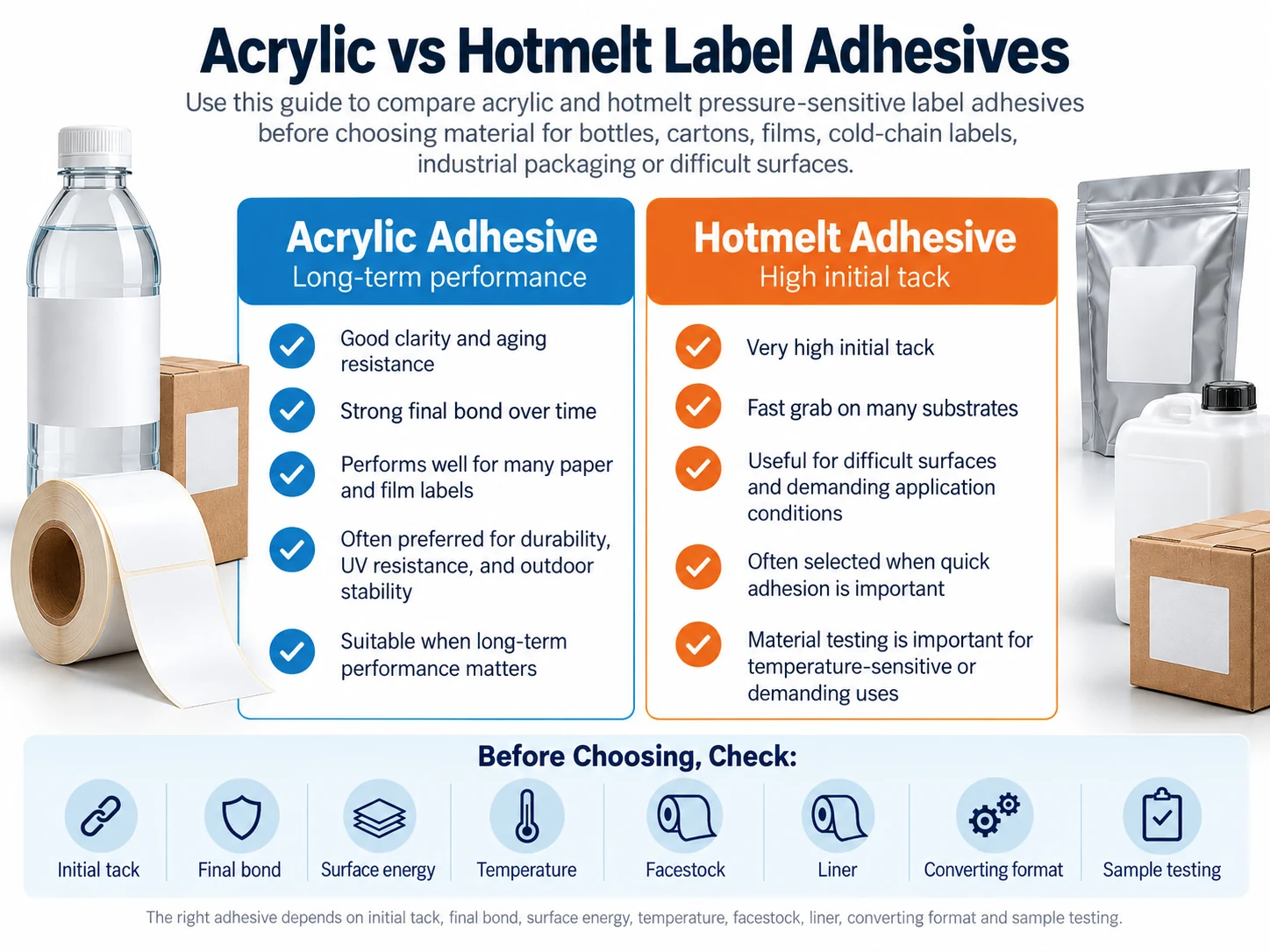
Acrylic vs hotmelt label adhesive at a glance
| Selection factor | Acrylic adhesive | Hotmelt adhesive | Buyer note |
|---|---|---|---|
| Adhesive type | Acrylic pressure-sensitive adhesive, often used for general packaging and film labels | Rubber-based or hot-melt pressure-sensitive adhesive, often used for high tack needs | Confirm exact grade before ordering |
| Initial tack | Moderate initial tack, bond builds after application | Strong initial grab | Hotmelt is useful when the label must grip quickly |
| Final bond | Stable bond on many smooth surfaces | Strong bond on rough or difficult surfaces when matched correctly | Test after 24 hours, not only immediately after application |
| Smooth surfaces | Good starting point for glass, PET, HDPE, coated packaging and many film labels | Can work, but may be more aggressive than needed | For clear film labels, check clarity and edge behavior |
| Rough surfaces | May lift on rough, recycled or low-energy surfaces | Better starting point for rough cartons, recycled board and textured packaging | Surface energy matters more than material name |
| UV and aging | Often preferred when cleaner aging and UV exposure matter | Usually less preferred for long UV exposure | Do not use outdoor claims unless the specific grade is tested |
| Heat and storage | Often more stable under warmer storage than general hotmelt grades | Can soften, ooze or lose stability if the wrong grade is used in heat | Confirm application temperature and service temperature separately |
| Cold or freezer use | Use only if the grade is designed for cold application or cold service | Some high-tack or freezer grades may be suitable | Compare freezer and cold-chain label material for these jobs |
| Residue and removal | Cleaner aging in many packaging uses, but still can leave residue if permanent | More residue or edge ooze risk in some conditions | If removal matters, compare permanent vs removable adhesive instead |
| Typical buyer use | Cosmetics, beverage, food, household, film labels, clear BOPP/PET packaging | Logistics cartons, rough packaging, tire labels, difficult surfaces, high-tack jobs | Match adhesive with facestock, liner and roll format |
Acrylic adhesive
Acrylic pressure-sensitive adhesive for smooth packaging surfaces, film labels and cleaner long-term aging.
View material specsHotmelt adhesive
Rubber-based hot-melt adhesive for strong initial tack on rough cartons, recycled board and difficult surfaces.
View material specsAcrylic adhesive vs Hotmelt adhesive: side by side
| Criterion | Acrylic adhesive | Hotmelt adhesive |
|---|---|---|
| Adhesive system | Acrylic pressure-sensitive adhesive, water-based or solvent-based depending on grade | Rubber-based hot-melt pressure-sensitive adhesive |
| Tack behaviour | Moderate initial tack; the bond continues to build after application | Strong initial grab from the moment the label is applied |
| Surface energy | Reliable on higher-energy, smooth and coated surfaces | Often the better option on low-energy plastics and porous, uneven board |
| Aging and UV | Generally cleaner aging; commonly specified where UV exposure matters | Usually less preferred for long UV exposure |
| Warm storage | Often more stable under warmer storage than general hotmelt grades | Can soften, ooze or block if the wrong grade is used in heat |
| Converting behaviour | Predictable die-cutting and matrix stripping in most constructions | Needs correct die settings and roll storage to avoid edge ooze |
| Typical jobs | Clear film labels, cosmetics, beverage, food and household packaging | Logistics cartons, recycled board, tire labels and other high-tack work |
When to choose acrylic adhesive
- Choose acrylic adhesive for smooth glass, PET, HDPE, coated paper and many film packaging surfaces.
- Choose acrylic adhesive when the buyer needs clean aging, good clarity or a lower risk of adhesive yellowing.
- Choose acrylic adhesive for clear BOPP, white BOPP, PET film and many normal packaging labels.
- Choose acrylic adhesive when the label needs stable long-term adhesion in regular storage and shelf conditions.
- Choose acrylic adhesive when the label is not being applied to a very rough, dusty, recycled or textured surface.
- Choose acrylic adhesive when UV exposure or clean appearance matters, subject to grade testing.
When to choose hotmelt adhesive
- Choose hotmelt adhesive when the label needs strong initial tack.
- Choose hotmelt adhesive for rough cartons, recycled fibre, textured packaging or difficult board surfaces.
- Choose hotmelt adhesive when the surface is low-energy and a general acrylic adhesive may lift at the edges.
- Choose hotmelt adhesive for some logistics, freezer, cold-chain, tire label or high-tack label jobs.
- Choose hotmelt adhesive when quick grip matters more than clean long-term appearance.
- Choose hotmelt adhesive only after checking heat, storage, converting and residue risk for the exact grade.
What is acrylic label adhesive?
Acrylic label adhesive is a pressure-sensitive adhesive used for many paper and film label materials. It is commonly selected for smooth packaging surfaces, clear film labels, food and beverage packaging, cosmetics, household products and applications where cleaner aging, UV resistance and stable long-term adhesion matter.
What is hotmelt label adhesive?
Hotmelt label adhesive, also written as hot melt adhesive, is a pressure-sensitive adhesive system often selected for stronger initial tack and difficult surfaces. It is commonly used when labels must grip rough cartons, recycled board, textured packaging, low-energy plastics, cold-chain packaging or high-tack applications such as tire label materials.
When neither a standard acrylic nor a standard hotmelt is the right answer
Some jobs need a special adhesive system rather than a general acrylic or hotmelt grade. If the label must come off cleanly, compare removable adhesive. If the container is washed and the label must release in the recycling stream, compare wash-off adhesive. If the label is applied or stored below freezing, ask for freezer and cold-chain material instead of a general-purpose grade.
Acrylic vs hotmelt adhesive by application
| Application | Recommended starting point | Why | Related page |
|---|---|---|---|
| Clear film label on a PET or glass bottle | Acrylic adhesive | Clarity, clean edges and stable bonding on a smooth surface | Film label materials |
| Cosmetics or household packaging | Acrylic adhesive | Cleaner aging and shelf appearance over a longer shelf life | Cosmetics label materials |
| Rough or recycled shipping carton | Hotmelt adhesive | Stronger initial tack on porous, textured or recycled fibre | Logistics label materials |
| Chemical drum or industrial container | Depends on surface and exposure | Surface energy, cleaning agents and service temperature decide the grade | Chemical & industrial label materials |
| Tire label | High-tack hotmelt adhesive | Tire labels need aggressive adhesion on a difficult curved surface | Tire label material |
| Freezer or cold-chain carton | Freezer-grade adhesive, not generic acrylic or hotmelt | Application temperature and service temperature must be checked separately | Freezer & cold-chain label material |
| Converter sourcing multiple adhesive options | Adhesives & release liners | Compare adhesive system, liner, tack, peel and temperature window together | Adhesives & release liners |
| Jumbo roll sourcing | Label stock jumbo rolls | Confirm facestock, adhesive, liner, width, core and MOQ in one sourcing path | Label stock jumbo rolls |
Adhesive is only one part of the label construction
Acrylic or hotmelt adhesive does not decide label performance by itself. The final result also depends on facestock, coating, release liner, printer, ink or ribbon, die-cutting setup, roll width, core size, application pressure, storage condition and the surface being labeled.
Facestock
- Paper facestock may work for dry indoor packaging and cartons.
- BOPP and PET film facestocks are often used for moisture resistance, shelf appearance or durability.
- PE film may be better for squeezable containers.
- Thermal materials require extra care because heat, light and abrasion can affect print life.
Release liner
- Glassine, PET liner and CCK/kraft liner can affect die-cutting, dispensing, label stability and converting speed.
- No single liner is always best; match the release value to the adhesive and the converting line.
Printing and converting
- UV flexo, thermal transfer, direct thermal, digital and screen printing may need different coating and adhesive choices.
- The adhesive should be tested after printing, die-cutting, rewinding and actual application.
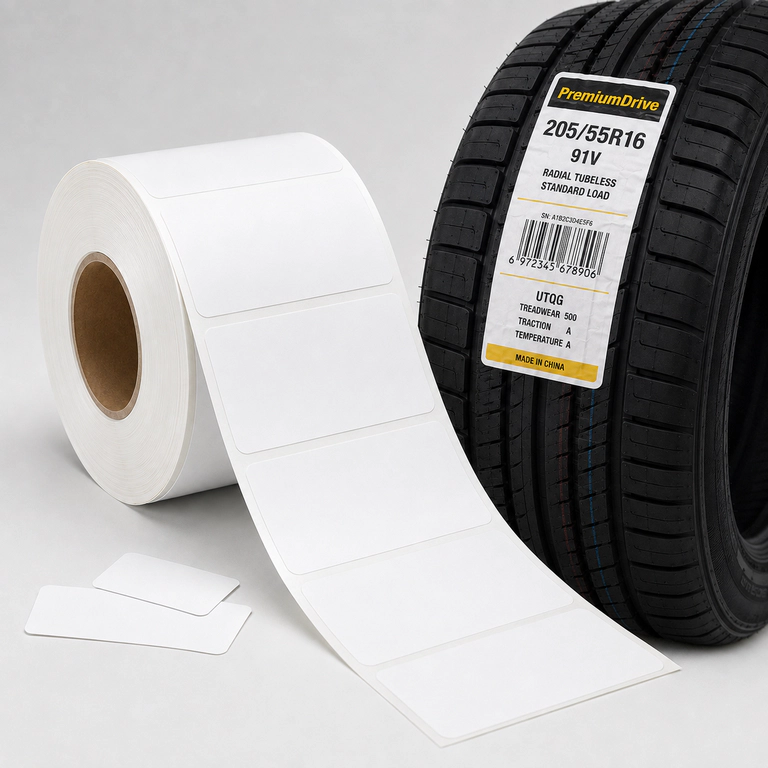
What to send before requesting adhesive samples
- Label application and end-use market
- Container or surface: glass, PET bottle, HDPE, PP, carton, recycled board, metal, tire, drum or electronics housing
- Surface condition: smooth, rough, curved, textured, dusty, oily, cold, squeezable or low-energy
- Facestock requirement: paper, BOPP, PET, PE, PVC, thermal paper or synthetic material
- Adhesive starting point: acrylic, hotmelt, high-tack, freezer, removable, wash-off or not sure
- Application temperature and service temperature
- Exposure: moisture, condensation, freezer, heat, UV, oils, alcohol, cleaning or chemicals
- Printing method: UV flexo, thermal transfer, direct thermal, digital, screen or offset
- Release liner preference: glassine, PET liner or CCK/kraft
- Roll format: jumbo roll, log roll or slit roll
- Roll width, core size and annual volume
- Need for A4 sheet samples, sample roll or trial order
- Target MOQ and requested lead time
Frequently asked questions
- Is acrylic or hotmelt adhesive better for labels?
- Neither is always better. Acrylic adhesive is often the better starting point for smooth packaging surfaces, clear film labels, clean aging and longer shelf life. Hotmelt adhesive is often better when labels need strong initial tack on rough cartons, recycled board, low-energy plastics or difficult surfaces.
- What is the difference between acrylic and hotmelt label adhesive?
- Acrylic label adhesive is commonly used for stable bonding, cleaner aging and many smooth paper or film label applications. Hotmelt label adhesive is usually selected for stronger initial grab and difficult surfaces such as rough cartons, recycled board, textured packaging or high-tack label applications.
- Is hotmelt adhesive good for cardboard labels?
- Hotmelt adhesive is often a good starting point for cardboard labels, especially on rough, recycled or textured cartons where quick tack is needed. The exact grade should still be tested on the real carton surface and storage condition.
- Is acrylic adhesive good for plastic bottle labels?
- Acrylic adhesive is commonly used for plastic bottle labels, including PET, HDPE and many film label applications. The final choice depends on bottle surface energy, curvature, moisture, filling condition, storage temperature and the selected facestock.
- Does hotmelt adhesive leave more residue?
- Some hotmelt adhesive grades can create more residue, edge ooze or blocking risk under the wrong heat, storage or converting conditions. If clean removal matters, compare removable adhesive or wash-off adhesive instead of using a standard permanent hotmelt grade.
- Can acrylic adhesive replace hotmelt adhesive?
- Acrylic adhesive can replace hotmelt in some smooth-surface packaging applications, but it may not be enough on rough cartons, recycled board, low-energy plastics or high-tack jobs. Test both constructions before changing production material.
- What information does AllinLabel need before quoting acrylic or hotmelt label material?
- Send the surface material, surface condition, facestock, adhesive requirement, application temperature, service condition, printing method, liner preference, roll width, core size, annual volume, sample need and target lead time.
Related material pages
- Adhesives & Release Liners
- Choosing the right label adhesive
- Permanent vs removable adhesive
- Hotmelt adhesive glossary
- Tire label material
- Freezer & cold-chain label material
- Film label materials
- Label stock jumbo rolls
- Food & beverage label materials
- Logistics & shipping label materials
- Chemical & industrial label materials
Need help choosing acrylic or hotmelt adhesive?
Send your container surface, facestock, printing method, roll width, adhesive requirement and service condition. AllinLabel can recommend a starting construction, provide samples and confirm whether acrylic, hotmelt, high-tack, freezer, removable or wash-off adhesive is the better fit for production.
Once the construction is decided, both options can be quoted as self-adhesive label stock rolls for slitting and rewinding in your own plant.
More comparisons
- BOPP vs PET Label Material: Which Film Facestock Should You Choose?
Compare BOPP and PET label materials by durability, clarity, heat resistance, chemical exposure, print method and roll format before requesting samples.
- Semi-gloss paper vs white BOPP label material
Compare semi-gloss coated paper and white BOPP film label material on water resistance, printability, conformability, cost and typical applications.
- Permanent vs removable label adhesive
Compare permanent and removable pressure-sensitive label adhesives on ultimate bond, residue, surface energy, temperature range and typical applications.
- Glassine vs PET release liner
Compare glassine paper and PET film release liners on tensile strength, die-cutting, dispensing speed, caliper, moisture stability and recycling.
- PP synthetic paper vs PE film label material
Compare PP synthetic paper and PE film label facestocks on stiffness, squeezability, tear resistance, printability and container compatibility.
Request a quote or a free sample
Send us your facestock, adhesive, liner and roll specification. Low MOQ, OEM/ODM, export to 60+ countries.