
Clear BOPP Label Material
Clear BOPP label material uses a transparent biaxially oriented polypropylene facestock in a pressure-sensitive laminate. It is a candidate for bottle and jar labels where the package should remain visible around the printed graphics. The film, adhesive, printing and container surface all affect the finished appearance.
Download Clear BOPP TDS (PDF) ↓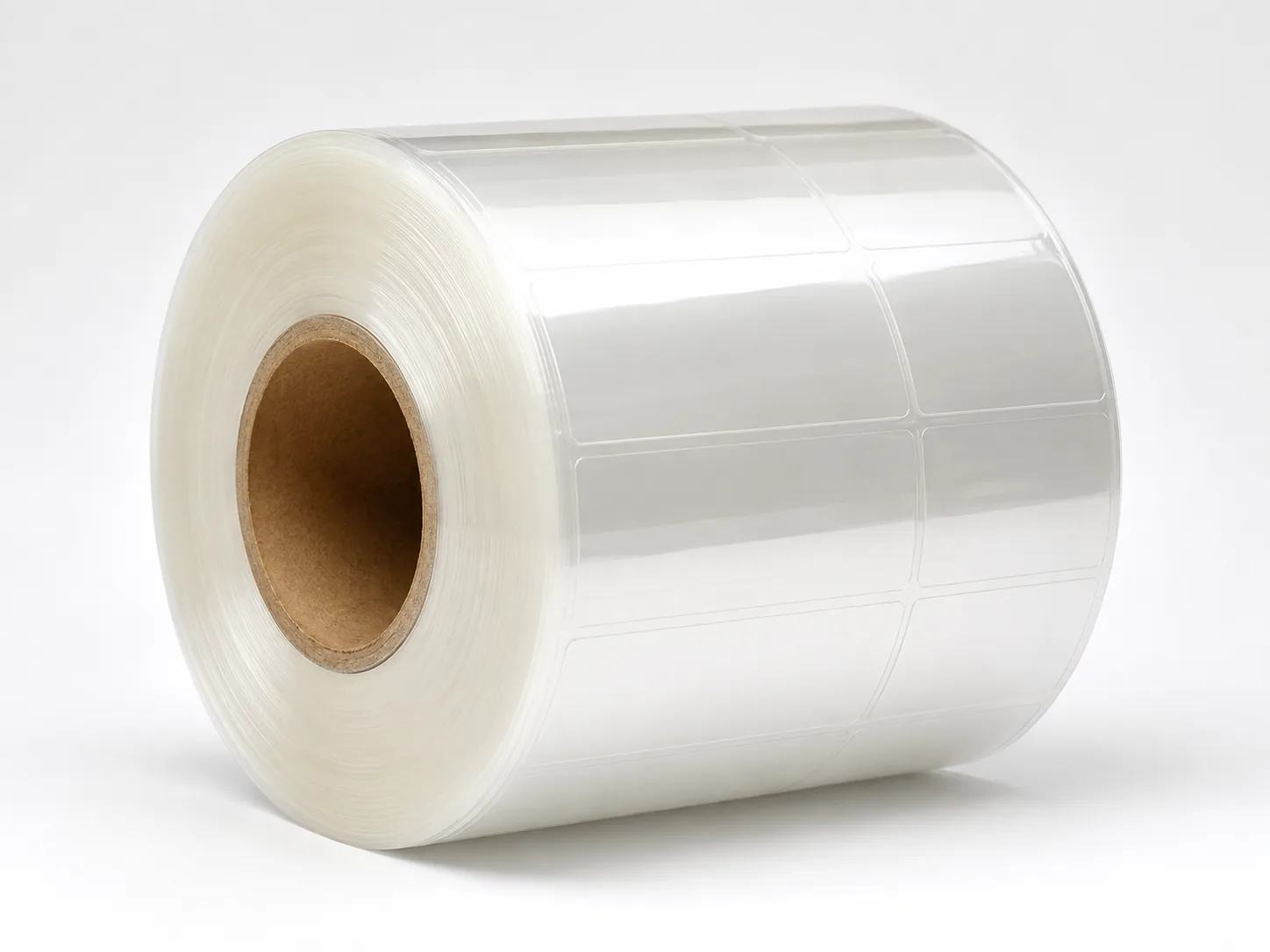
Key specifications
| Facestock | Clear (transparent) BOPP, top-coated |
|---|---|
| Face thickness | 30–50 µm |
| Finish | High-clarity gloss |
| Adhesive | Permanent acrylic, removable, freezer, high-tack (water-based or hot-melt) |
| Release liner | White glassine, PET, or CCK/kraft |
| Formats | Jumbo roll, log roll, finished slit rolls |
| Max width | Up to 1,600 mm |
| Core sizes | 25 mm (1 in) / 76 mm (3 in) |
| MOQ | From 1 jumbo roll (stock), 3,000–5,000 m² (custom) |
| Certifications | ISO 9001 / ISO 14001 |
What are you specifying?
A self-adhesive construction includes the clear film face, pressure-sensitive adhesive and release liner. The face is not the same as uncoated packaging film or a finished printed label. Its surface treatment or coating must suit the intended printing process.
Start with the container and artwork, then confirm a construction. A film name alone does not establish optical quality, ink adhesion or performance on a chilled bottle.
Will clear BOPP create a no-label look?
Clear film allows the container to show through, but the label does not become invisible in every condition. Adhesive appearance, air trapped during application, container texture and the printed finish can reveal the label area.
Review a printed sample on the actual container, including the filled pack if its contents affect the appearance. Look at unprinted areas, printed areas and label edges under the lighting the package will encounter. If the pack will be chilled or become wet, include that exposure in the review.
White ink can provide a background behind selected graphics. Its coverage and opacity belong in the artwork and press trial; they are not established by choosing clear film.
Construction details to confirm
| Part of the request | Specify | Review before approval |
|---|---|---|
| Film face | Required appearance, thickness and printing process | Grade identity, surface treatment and sample appearance |
| Adhesive | Container material, surface condition, permanence and exposure | Bond on the actual container and appearance through unprinted areas |
| Release liner | Die-cutting, matrix stripping and dispensing equipment | Release, liner condition and machine fit with the chosen construction |
| Printed finish | Inks, white coverage, varnish or overlaminate | Legibility, ink adhesion and finished appearance |
| Roll supply | Width, length, core, maximum outer diameter and winding direction | Available format and compatibility with the converting line |
Ask for the grade identification and its technical data sheet. Confirm which face, adhesive and liner combination the sample represents before comparing it with another roll.
Match the surface to the printing process
A printable clear film is not automatically compatible with every press or ink. Include the equipment model, ink system and finishing process in the request.
- For flexographic printing, state whether the ink is UV-curable, water-based or solvent-based.
- For digital inkjet, identify the printer and ink chemistry. UV inkjet and water-based inkjet must be assessed separately.
- For toner or thermal-transfer printing, request confirmation for the actual grade and imaging system rather than relying on a general digital-printing claim.
Assess the completed print after the agreed drying or curing process. Include any white ink, varnish or laminate used in production. For an existing print-adhesion problem, use the film ink-adhesion troubleshooting guide before assuming a different film will solve it.
Chilled, wet or reusable packaging
A water-resistant face does not establish how the printed label or adhesive will perform. Describe whether the container is dry, wet or condensing when the label is applied, as well as the conditions it will encounter later.
Minimum application temperature and service temperature answer different questions. Request both for the proposed construction; do not infer them from the polymer name.
If the label must come off for reuse or a recycling process, specify that process. Removable and wash-off adhesives are not interchangeable requirements, and clear BOPP alone does not establish recycling compatibility.
See the glass bottle and jar application guide or PET bottle application guide for container-specific checks.
When should you compare another material?
| Your requirement | Material to compare | What still needs checking |
|---|---|---|
| A white background rather than transparency | White BOPP | Opacity, artwork and the complete construction |
| Repeated movement of a soft bottle or tube | PE film | Container movement, geometry and the printed label |
| A transparent label with a different durability requirement | PET film | The specific grade, adhesive, exposure and print system |
These are comparison routes, not approvals. For a closer film comparison, read BOPP vs PET label material.
Request a sample for your packaging
Send the container material and shape, label dimensions, artwork requirements, printing method and expected exposure. Include the roll width, core, maximum outer diameter, winding direction and order quantity.
State whether you need a swatch for appearance checks or a roll for printing, die-cutting and application trials. Sample availability, charges, freight, MOQ and lead time need confirmation for the requested construction and format.
Buying rolls for converting? Review the jumbo and slit roll procurement requirements. For component selection, see adhesives and release liners.
Related materials
Frequently asked questions
Will the label edge disappear on every bottle?
No. The edge may remain visible, and the result depends on the film, adhesive, container and application. Approve the appearance on a representative printed pack, not only an unprinted swatch.
Can clear BOPP be used on a squeeze bottle?
Container movement must be assessed. For a bottle that flexes repeatedly, compare a conformable film and test the actual label geometry. Do not assume a clear appearance establishes squeeze performance.
Does a PET liner make a label clearer?
The liner is removed during labeling. Its role is in the supplied construction, converting and release. Evaluate the face, adhesive and application on the container for the finished appearance.
Does this material need a special grade for digital inkjet?
Confirm the film surface against the printer and ink system. A grade assessed for UV inkjet should not be assumed suitable for water-based inkjet, toner or another process.
Request Clear BOPP samples or a quote
Send the container, artwork, printing method, exposure and roll requirements so the sample and quotation match the actual job.