
PET Label Material
PET (polyester) label material is a strong, dimensionally stable film facestock that resists heat, chemicals, tearing and abrasion. Available white, clear, matte or silver, it is used for durable industrial, electronic and chemical labels that must survive harsh conditions.
Quick answer
PET (polyester) label material is a dimensionally stable film facestock (23–50 µm), available white, clear, matte or silver, with high heat, chemical and abrasion resistance. It is used for durable industrial, electronic and pharmaceutical labels that must hold register and legibility through harsh handling and cleaning.
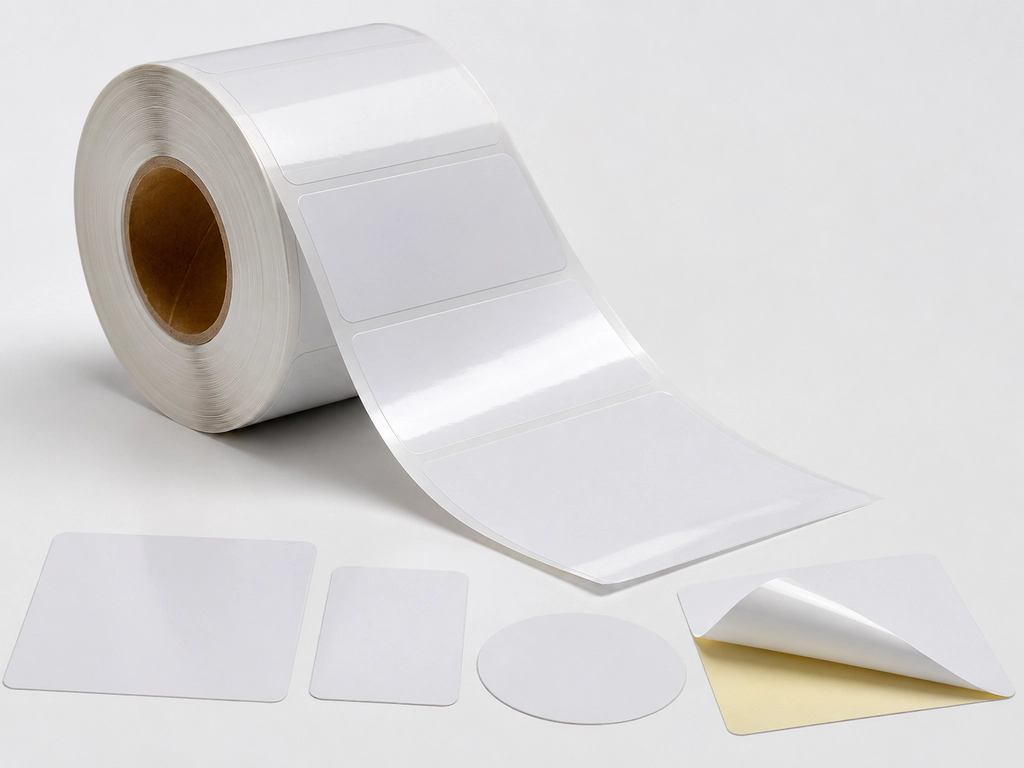
Key specifications
| Facestock | PET (polyester) film — white / clear / matte / silver |
|---|---|
| Face thickness | 23–50 µm |
| Finish | Gloss, matte or metallic |
| Adhesive | Permanent acrylic, removable, freezer, high-tack (water-based or hot-melt) |
| Release liner | White glassine, PET, or CCK/kraft |
| Formats | Jumbo roll, log roll, finished slit rolls |
| Max width | Up to 1,600 mm |
| Core sizes | 25 mm (1 in) / 76 mm (3 in) |
| MOQ | From 1 jumbo roll (stock), 3,000–5,000 m² (custom) |
| Certifications | ISO 9001 / ISO 14001 |
Why choose PET film
Heat, chemical and solvent resistant
Withstands elevated temperatures, cleaning solvents and aggressive chemicals without distorting.
High tensile strength
Tear and abrasion resistant, so labels survive rough handling and industrial service life.
Dimensionally stable
Holds register through die-cutting and multi-colour print, even in thin gauges.
Long service life
Retains legibility indoors and outdoors over years of exposure.
Typical applications
Chemical & industrial
Drums, containers and machinery labels exposed to solvents, oils and abrasion.
Learn more →Electronics & durable goods
Rating plates, serial and warranty labels that must resist heat and cleaning.
Pharmaceutical & healthcare
Device and laboratory labels needing chemical resistance and dimensional stability.
Learn more →
Adhesive & liner options
PET film is laminated to permanent acrylic, high-tack, freezer or removable adhesives — including high-temperature grades — on white glassine, PET or CCK/kraft liners.
Related materials
Still deciding between polypropylene and polyester film? BOPP vs PET label material by durability, heat and chemical exposure, print method and roll format.
Buying this material for converting? See jumbo roll and slit roll supply options for PET label material jumbo rolls and match the facestock, adhesive and liner in one specification.
Frequently asked questions
What is PET label material?
PET label material is a dimensionally stable polyester film facestock, commonly 23–50 µm, supplied clear, white, matte or silver. It offers high heat, chemical and abrasion resistance with very little stretch, so printed detail and register hold up under cleaning, solvents and mechanical handling that would distort softer films or destroy paper labels.
It is specified for durable rating plates, electronics and battery labels, laboratory and pharmaceutical containers, automotive components and asset tags that must stay readable for the life of the product.
Choose gauge for stiffness and die-cutting, adhesive for the substrate and service temperature range, and print method — thermal transfer with resin ribbon, UV flexo or screen give the most durable images. Where labels face solvents, autoclaving or long outdoor exposure, resistance depends on the exact chemistry and cycle — confirm with sample testing.
What is PET label material used for?
Durable industrial, electronic, chemical and healthcare labels that must resist heat, solvents, tearing and abrasion.
Why is PET more durable than BOPP?
PET (polyester) has higher heat and chemical resistance and tensile strength, so it survives harsher environments than polypropylene film.
Does PET label film resist high temperatures?
Yes. PET tolerates far higher temperatures than paper or BOPP, suiting electronics, engine-bay and autoclave-adjacent uses.
What finishes does PET come in?
White, clear, matte and silver, so it covers durable, transparent and metallic requirements.
What is the maximum service temperature for PET label material?
PET tolerates significantly higher temperatures than paper or BOPP film, making it suitable for hot-fill, engine-bay-adjacent and sterilisation-cycle labelling; the exact continuous and peak temperature rating depends on facestock thickness and adhesive grade, and is confirmed on the technical datasheet for your specific construction.
Which ribbon type should I use to thermal-transfer print PET labels?
Use a resin ribbon for thermal transfer printing on PET film — wax and wax-resin ribbons do not anchor reliably to polyester and will smear or scratch off. Resin ribbon on PET gives the chemical, heat and abrasion resistance PET labels are chosen for.
What liner and die-cutting options are available for PET film labels?
PET film is supplied on white glassine, PET or CCK/kraft liner, matrix-stripped and die-cut to your label shape, on 25 mm (1 in) or 76 mm (3 in) cores up to 1,600 mm wide. Request a free sample and datasheet so we can confirm die compatibility for your shape.
What is the minimum order quantity (MOQ)?
Stocked grades start from 1 jumbo roll. Custom constructions or coatings typically start from 3,000–5,000 square meters, depending on complexity.
What adhesive and liner options are available?
Permanent, removable, deep-freeze, high-tack or wash-off adhesive (water-based or hot-melt), on white glassine, PET or CCK/kraft liner — matched to your surface and environment.
Request a free sample of PET Label Material
Send us your facestock, adhesive, liner and end-use details. We ship free A4 sheets or a trial roll with the technical datasheet, and confirm MOQ, lead time and FOB pricing within one working day.
Get PET label material, cut to your spec.
Tell us your facestock, adhesive, liner and roll requirements — we quote within one business day. Free samples available.