
Recyclable Label Material
Recyclable-compatible label material is designed so the label does not disrupt the recycling of the container — using facestock and adhesive combinations compatible with PET or HDPE streams. It helps brands meet design-for-recycling guidelines and EPR requirements.
Quick answer
Recyclable-compatible label material is a facestock and adhesive combination selected so the label does not contaminate PET or HDPE recycling streams when it stays on the container. It is used on recyclable bottles and containers by brands needing to meet design-for-recycling and EPR requirements, and can be paired with wash-off adhesive or rPET facestock.
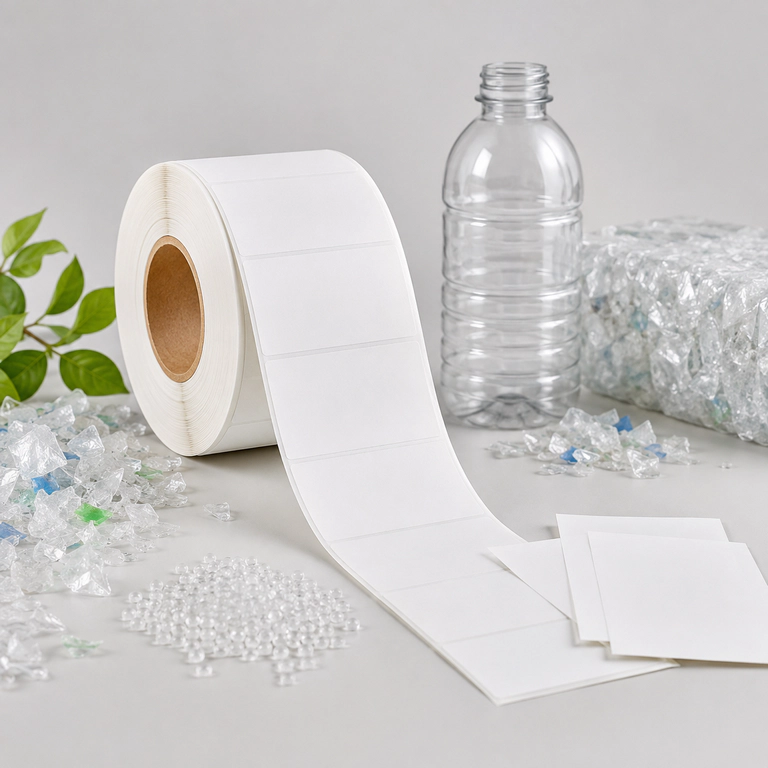
Key specifications
| Design | Design-for-recycling |
|---|---|
| Compatibility | PET and HDPE recycling streams |
| Options | Wash-off or recycling-compatible adhesive |
| Release liner | White glassine, PET, or CCK/kraft |
| Formats | Jumbo roll, log roll, finished slit rolls |
| Max width | Up to 1,600 mm |
| Core sizes | 25 mm (1 in) / 76 mm (3 in) |
| MOQ | From 1 jumbo roll (stock), 3,000–5,000 m² (custom) |
| Certifications | ISO 9001 / ISO 14001 |
Why choose recyclable label material
Compatible with PET / HDPE recycling
Constructions selected to pass through mainstream bottle and container streams.
Doesn't contaminate the recyclate
Facestock and adhesive chosen so the recovered polymer stays clean and usable.
Supports EPR and design-for-recycling rules
Aligned with packaging-recyclability criteria in EPR-driven markets.
Pairs with wash-off or rPET options
Combine recycled-content facestock and wash-off adhesive for the strongest profile.
Typical applications
Recyclable bottles & containers
PET and HDPE packs for food, beverage and household products.
Learn more →Sustainable retail & cosmetics
Brands whose packaging must carry a defensible recyclability claim.
Learn more →EPR-driven markets
Regions where packaging fees or rules reward recyclable label constructions.
Compare with related sustainable materials
Selection depends on container, adhesive, liner, printing method and the local recycling stream.
Recyclable-compatible construction
Best for: Labels designed around a defined container and recycling stream
Watch-outs: Requirements differ by region and recycler; validation is needed
This page →Wash-off adhesive
Best for: Full label separation in bottle washing or PET recycling
Watch-outs: Release depends on wash chemistry and temperature
Wash-off adhesive →rPET / PCR facestock
Best for: Recycled content targets on the label face itself
Watch-outs: Recycled content is separate from end-of-life compatibility
rPET & PCR facestock →FSC-certified paper
Best for: Paper-based packaging and certified fibre sourcing
Watch-outs: Not suited to wet, chilled or oily packaging
FSC paper →
Compatibility directions by package type
Directional guidance only. Confirm against your own container, inks and the recycling requirements that apply in your market.
| Package | Label material direction | Adhesive consideration | Testing note |
|---|---|---|---|
| PET bottle | Clear or white BOPP, PET or wash-off paper construction | Wash-off or recycling-friendly adhesive so the flake stream stays clean | Test label separation, ink bleed and flake contamination |
| HDPE container | PE or PP-based facestock for mono-material thinking | Adhesive that stays bonded in service, without contaminating the flake | Test bond in distribution, then behaviour in the recycler's process |
| PP container | PP synthetic or BOPP facestock | Standard permanent acrylic is common; confirm with the recycler | Check density and flotation behaviour in the sorting step |
| Glass bottle | Paper or film facestock depending on decoration and refill | Wash-off adhesive for refill or bottle-washing lines | Test residue on glass after the washer cycle |
| Paper / carton pack | Paper facestock aligned with fibre recycling | Adhesive that behaves acceptably in the pulping step | Check repulpability requirements applying to your market |
When this material may not be the best fit
A label alone does not make a package recyclable. Compatibility depends on the container, facestock, adhesive, ink, varnish and the recycling stream that actually processes the pack.
If the pack is washed for refill or must release the label completely during reprocessing, a wash-off adhesive construction is usually the more direct answer.
Adhesive & liner options
Choose a recycling-compatible permanent adhesive, or wash-off where the label must leave the container entirely. Tell us the container polymer and target recycling stream and we will specify the pairing.
Related materials
Buying this material for converting? See jumbo roll and slit roll supply options for recyclable-compatible label stock rolls and match the facestock, adhesive and liner in one specification.
Before requesting a quote
Have these details ready so we can propose a construction instead of a generic price.
- Container resin or substrate: PET, HDPE, PP, glass or paper/carton
- Target recycling stream and local recycling requirements
- Whether mono-material construction is required
- Facestock and adhesive direction already specified by your brand team
- Ink, varnish and lamination used on the label face
- Label size, roll width, core size and winding direction
- Printing method and press type
- Service environment before the pack reaches recycling
- Annual volume, first-order volume and test sample requirement
Request samples, MOQ and lead time
To check availability, sample options and lead time, send us your application, label size, roll width, facestock, adhesive, liner, printing method and estimated order volume. Our team will recommend a suitable construction and confirm whether a sample roll or trial order is available.
Selection depends on container, adhesive, liner, printing method and service environment. We confirm every construction against your own substrate and line conditions before bulk production.
Frequently asked questions
What is recyclable label material?
Recyclable-compatible label material is a facestock and adhesive combination chosen so the label does not contaminate the recycling stream of the container it stays on. Density, colour and adhesive behaviour are selected to suit PET or HDPE reprocessing, supporting design-for-recycling guidelines rather than adding a step that has to be undone later.
It is used by brands meeting EPR and eco-modulation requirements, retailers with packaging guidelines, and converters advising customers on recycling-ready constructions for bottles, jars and containers.
Start from the container polymer and the recycling route in your market, then decide whether the label should remain attached through reprocessing or wash off, and pick adhesive and facestock accordingly — rPET facestock and wash-off adhesive can be combined. Requirements differ by country and recycler — verify against local guidelines and confirm with sample testing.
What makes a label material recyclable?
A facestock and adhesive combination that separates from, or is compatible with, the container's recycling stream so it doesn't contaminate the recyclate.
Which recycling streams are supported?
Constructions compatible with PET and HDPE streams; the right choice depends on the container and local recycling.
Does this help with EPR compliance?
Yes, design-for-recycling label materials support Extended Producer Responsibility and packaging-recyclability rules.
What's the difference from wash-off?
Wash-off removes the label in the wash; recyclable-compatible constructions are chosen so the label doesn't harm recycling even if it stays on.
Which print methods work on recyclable-compatible label material?
Recyclable-compatible constructions print by standard flexo, offset, UV inkjet and digital methods, since compatibility is built into the facestock and adhesive pairing rather than the print process — confirm your press and target recycling stream and we will specify the construction.
What roll widths and MOQ apply to recyclable-compatible label material?
Constructions are supplied up to 1,600 mm wide, from a single jumbo roll for stock adhesive/facestock pairings, with custom combinations typically from 3,000–5,000 m². Tell us the container polymer and target market for a tailored quote.
Can I get a free sample of recyclable-compatible label material?
Yes, request a free sample paired with the recycling-compatible or wash-off adhesive of your choice, along with the datasheet, so you can validate recyclability with your container supplier or recycler before committing to production.
What is the minimum order quantity (MOQ)?
Stocked grades start from 1 jumbo roll. Custom constructions or coatings typically start from 3,000–5,000 square meters, depending on complexity.
What adhesive and liner options are available?
Permanent, removable, deep-freeze, high-tack or wash-off adhesive (water-based or hot-melt), on white glassine, PET or CCK/kraft liner — matched to your surface and environment.
Request a free sample of Recyclable Label Material
Send us your facestock, adhesive, liner and end-use details. We ship free A4 sheets or a trial roll with the technical datasheet, and confirm MOQ, lead time and FOB pricing within one working day.
Get recyclable label material, built to your spec.
Tell us your facestock, adhesive, liner and roll requirements — we quote within one business day. Free samples available.