
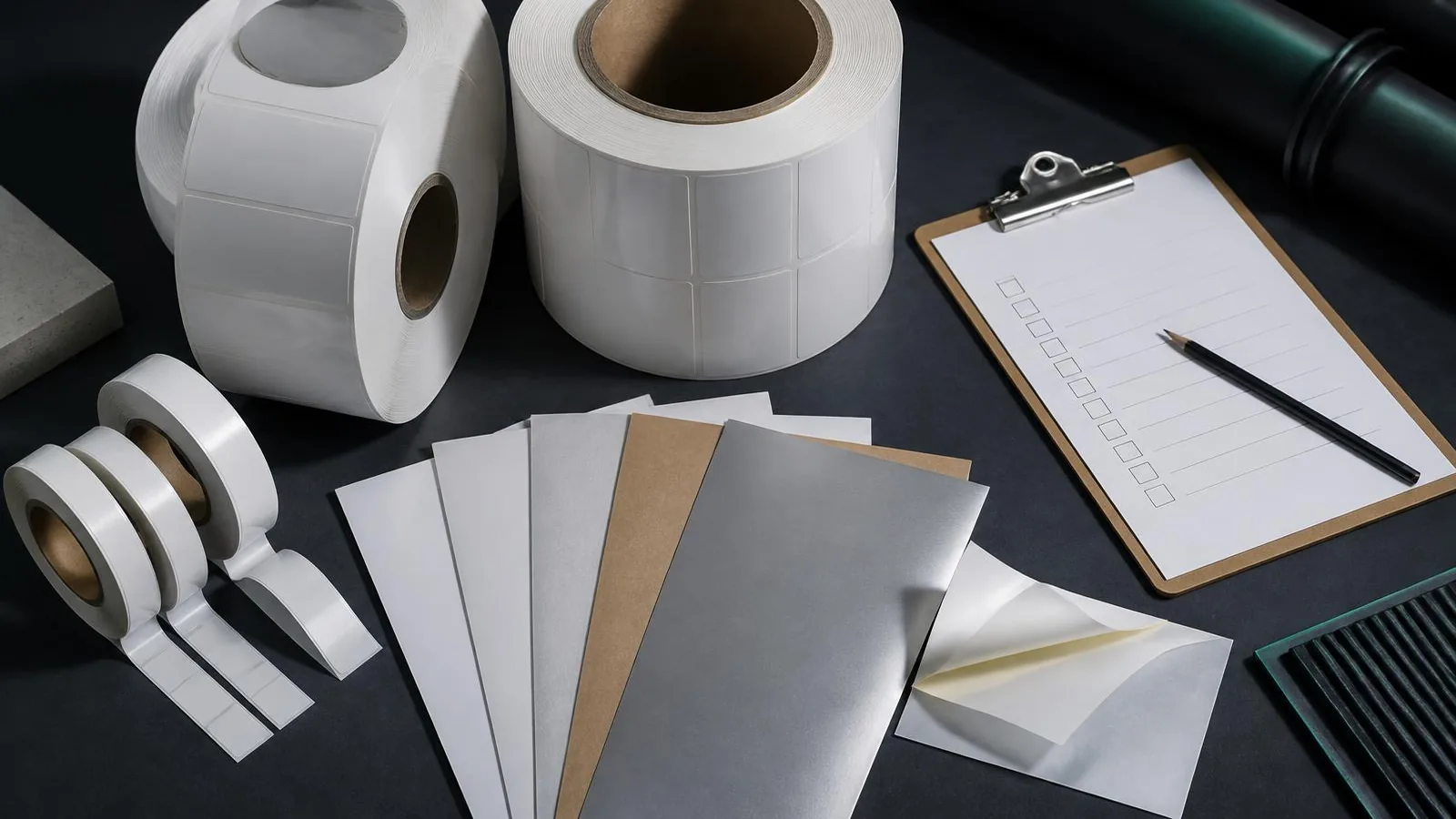
What information should buyers send before requesting samples?
A sample request is only useful if the sample matches the job. The checklist below is what a technical team needs to select a candidate construction rather than send a generic swatch pack. You can browse the full range on the label material products pages while you compile it.
- Product application — what the label identifies: a beverage bottle, a drum, a shipping carton, a cosmetic jar. This sets the whole shortlist.
- Container or substrate — glass, PET, HDPE, PP, corrugated board, metal or rubber. Surface energy and texture decide the adhesive more than anything else.
- Service temperature and environment — application temperature, storage temperature, moisture, freezer, heat, oil, solvents or outdoor exposure.
- Facestock — paper, BOPP, PET, PE, synthetic paper or a finish preference such as matt, gloss, kraft or metallised. If you are unsure, describe the look instead.
- Adhesive — permanent, removable, high-tack, freezer or wash-off. See [adhesives and release liners](/products/adhesives-release-liners/) for the families we coat.
- Release liner — glassine, PET or kraft, plus any liner thickness the applicator requires.
- Print method — flexo, offset, digital toner, UV inkjet, direct thermal or thermal transfer. [Thermal label materials](/products/thermal-label-materials/) have their own topcoat requirements.
- Roll width, core and outer diameter — plus the direction of unwind if the applicator is fixed.
- Estimated order volume — square metres, linear metres or number of labels per order and per year.
- Destination country or port — this affects packing, documents and shipping mode.
- Compliance or certification needs — food-contact indirect use, FSC, RoHS/REACH declarations or a technical data sheet.
- Whether you need A4 swatches or a trial roll — swatches for feel and print trials, a roll for machine trials.
Sample types: A4 swatches vs sample rolls
Not every question needs a roll. Matching the sample type to the test you actually want to run saves a shipping cycle. AllinLabel may provide A4 swatches or trial rolls depending on the construction and availability.
| Sample type | Best for | What buyers can test | Notes |
|---|---|---|---|
| A4 swatches | Early shortlisting and visual sign-off | Appearance, opacity, stiffness, feel, basic adhesion by hand, small-format digital print | Fastest to prepare; not suitable for line-speed or applicator trials |
| Trial roll / sample roll | Press and applicator trials | Print quality at speed, die-cutting and matrix stripping, dispensing, label lay-flat, adhesion on the real container | Width, core and outer diameter should match your press or applicator |
| Existing stock construction sample | Standard applications and faster turnaround | The same construction you would receive in production | Usually the quickest option because no coating run is required |
| Custom construction sample | Non-standard facestock, adhesive, liner or coating | A combination built for your application and environment | Availability and timing are confirmed after technical review |
How MOQ is usually confirmed for label materials
MOQ means the minimum order quantity required to produce or supply a specific label material construction. Stock constructions usually have lower MOQ, while custom facestock, adhesive, liner or coating combinations may require higher production volume.
There is no single MOQ across a label material range, and any supplier quoting one number for everything is simplifying. The quantity depends on whether the construction is already coated and in stock, and on the facestock, adhesive, liner, any special coating, the slitting width you need and the total volume of the order.
Slitting matters more than buyers expect: an unusual width can leave trim that cannot be sold to anyone else, so the economic minimum rises. Ordering two or three widths from one master roll often lowers the effective minimum.
Some product pages state indicative quantities for that construction. For your exact specification, check the MOQ definition in our glossary and then send the specification for confirmation.
- Stock construction, standard width — normally the lowest minimum.
- Stock construction, unusual slit width — minimum rises with trim waste.
- Custom adhesive or coating — a full coating run may be required.
- Custom facestock sourced to order — minimum follows the supplier of that face material.
What affects label material lead time?
Lead time is a result of the specification, not an attribute of the supplier. AllinLabel confirms lead time after reviewing the material construction, volume and destination.
- Stock availability — whether the jumbo roll is already coated and on the floor.
- Custom coating or adhesive requirement — a dedicated coating run has to be scheduled.
- Slitting and roll format — width, core, outer diameter and packing all take converting time.
- Sample testing — the approval cycle on your side is often the longest single step.
- Certification or document requests — declarations and technical data sheets are prepared before shipment.
- Destination country and shipping method — sea, air or courier, plus export documentation.
- Peak season or production queue — demand cycles shift the schedule for everyone.
How to get a faster quote from AllinLabel
Most quotation delays are caused by a missing detail that forces a second round of questions. Six steps remove almost all of them.
- 1. Describe the application — what the label is for and where it ends up.
- 2. Share the substrate and service environment — container material, temperature range, moisture, chemicals.
- 3. Choose or describe the facestock — paper, film or synthetic, with the finish you want.
- 4. Confirm adhesive and liner needs — permanent, removable, freezer, high-tack or [wash-off adhesive](/products/sustainable-label-materials/wash-off-adhesive/), plus the liner your applicator needs.
- 5. Add print method and roll format — press or printer type, roll width, core and outer diameter.
- 6. Send estimated order volume and destination — per order and per year, with the port or country.
Buyer checklist before sending a sample request
Run through these questions once before you write the enquiry. Each answer removes a round trip.
| Question | Why it matters | Example |
|---|---|---|
| What will the label be applied to? | Defines the shortlist of facestock and adhesive families | 500 ml shampoo bottle |
| Is the surface glass, PET, HDPE, paper, rubber or metal? | Surface energy and texture decide adhesion | HDPE, slightly textured |
| Will the label face moisture, freezer, heat, oil or chemicals? | Sets the service window the construction must survive | Shower moisture, 5–40 °C |
| What print method will be used? | Topcoat and surface treatment differ per process | UV flexo, four colours |
| Do you need permanent, removable, freezer, high-tack or wash-off adhesive? | Adhesive choice drives both performance and MOQ | Permanent acrylic |
| What roll width, core and outer diameter do you need? | Slitting format affects converting time and minimum quantity | 330 mm, 76 mm core, 800 mm OD |
| What is your estimated order volume? | Determines whether the construction is stock or a coating run | 40,000 m² per year |
| Which country or port will the goods ship to? | Affects packing, documents and shipping mode | Rotterdam, sea freight |
When should you ask for technical advice instead of only a price?
Price comparison works when the construction is settled. When it is not, a technical review first is cheaper than re-labelling later. Ask for advice before quotation in these cases:
- New packaging surface — a container material, coating or texture you have not labelled before.
- Cold-chain or freezer use — application temperature and condensation change the adhesive choice.
- Wash-off or recycling requirement — the label has to release cleanly in a defined wash process.
- Tyre or rubber application — plasticiser migration and low surface energy need a specific construction.
- Chemical or outdoor exposure — solvents, UV and abrasion decide the facestock and any laminate.
- Pharmaceutical or compliance-sensitive use — documentation and traceability requirements come first.
- Barcode durability requirement — scan life after abrasion, heat or moisture should be confirmed with sample testing.
Ready to request samples or confirm MOQ?
Tell AllinLabel your application, facestock, adhesive, liner, print method, roll size and volume. The technical team will review the construction and help confirm samples, MOQ, lead time and pricing.
Use the quote and sample request form for a full specification, or contact sales if you would rather talk the application through first.
Request a QuoteFrequently asked questions
- Can I request free label material samples from AllinLabel?
- AllinLabel may provide A4 swatches or trial rolls depending on the construction and availability. Stock constructions are usually the easiest to sample; custom facestock, adhesive or coating combinations are confirmed after technical review. Send your application, substrate, print method and roll format and the team will advise what can be prepared.
- What information is needed for a label material quote?
- Send the application, container or substrate, service environment, facestock preference, adhesive type, release liner, print method, roll width, core and outer diameter, estimated order volume and destination country. With those details a construction can be recommended and MOQ, lead time and pricing confirmed without a second round of questions.
- What is the difference between an A4 swatch and a sample roll?
- An A4 swatch is a flat sheet for judging appearance, opacity, stiffness, feel and basic adhesion, and for small digital print tests. A sample roll is slit to your width, core and outer diameter so you can run press, die-cutting and applicator trials at production speed on the real container.
- How is MOQ decided for self-adhesive label materials?
- MOQ is the minimum quantity needed to supply a specific construction. Stock constructions usually carry a lower minimum. Custom facestock, adhesive, liner or coating combinations may require a full production run, and unusual slitting widths raise the minimum because of trim waste. Quantities are confirmed per specification.
- How long does it take to confirm pricing, MOQ and lead time?
- Timing depends on whether the construction is a stock item or needs a custom coating, and on how complete the enquiry is. A specification that includes application, substrate, adhesive, liner, print method, roll format and volume can normally be reviewed and answered after technical review without further clarification.
- Can AllinLabel recommend the facestock, adhesive and liner if I am not sure?
- Yes. Describe the application, container material, service environment, print method and roll format and the technical team can propose a construction rather than asking you to specify one. Where performance depends on the real container and process, the recommendation should still be confirmed with sample testing.
- Should I test samples before placing a production order?
- Testing is recommended whenever the surface, environment or print process is new to you. Check adhesion on the actual container, print and die-cut behaviour on your press, dispensing on the applicator, and durability against moisture, temperature or abrasion. Bench results should be confirmed under real production conditions.
If you are buying material before converting, start from self-adhesive label stock rolls and then narrow the facestock, adhesive and liner with our technical team.
Related materials
Related reading
More guides on buyer guide and related topics
 TroubleshootingWhy Labels Bubble, Wrinkle and Tunnel on Bottles and ContainersBubbles, wrinkles and tunnels look alike but have different causes: trapped air at application, gas from the container, a label that cannot follow the shape, or stress built into the roll.9 min read
 TroubleshootingWhy Labels Fail to Dispense and Liners Break on High-Speed ApplicatorsLabels that stay on the liner, fly past the product, or a liner that snaps mid-run usually trace back to release, die-strike, liner choice, tension or peel-plate setup.9 min read
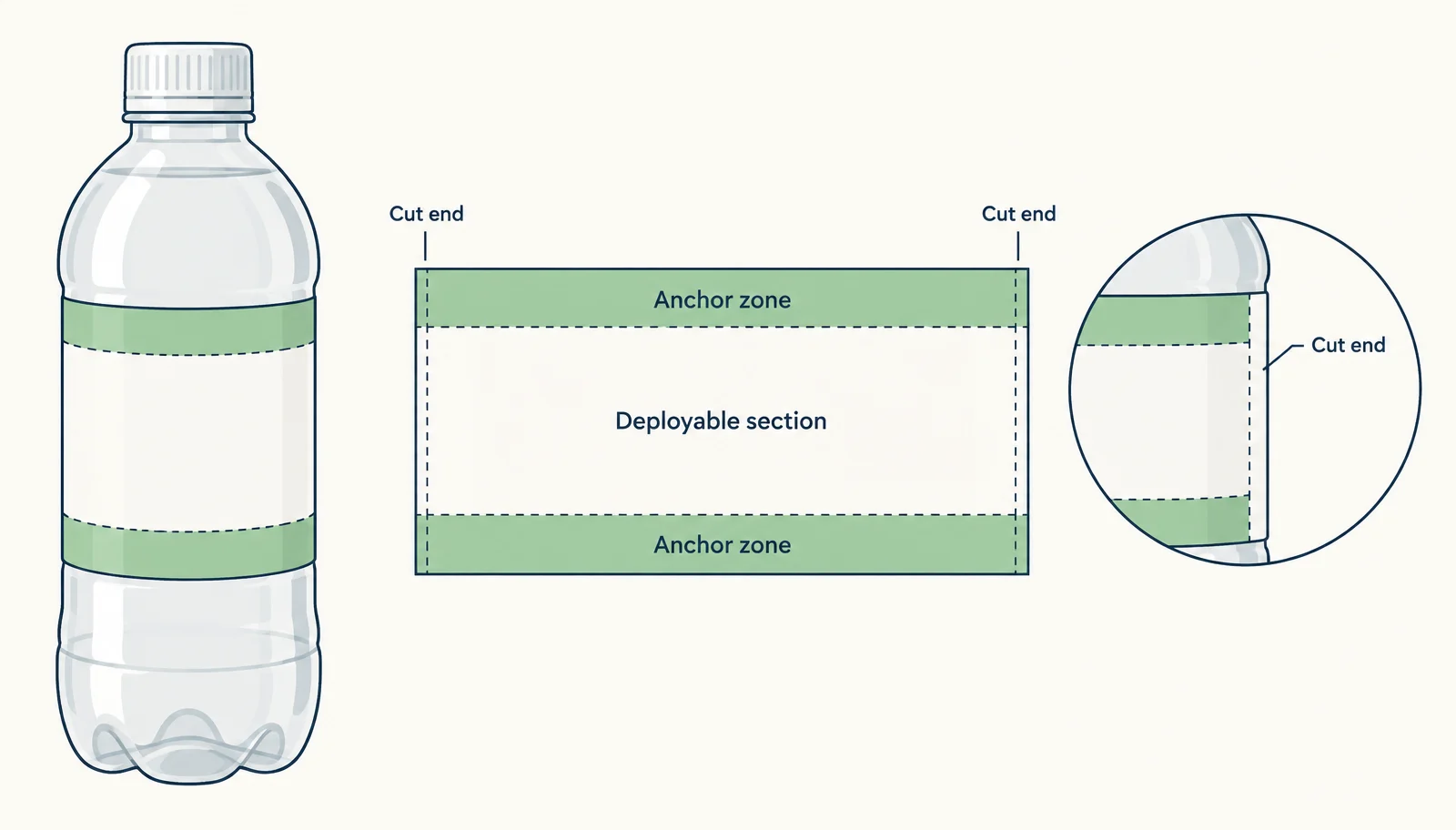 TroubleshootingWhy High-Elongation PE Film Can Still Tear in Bottle-Strap LabelsHigh elongation does not qualify a bottle-strap label. Learn how to separate cut-edge tears, permanent stretch and anchor movement before changing PE film.9 min read
Request a quote or a free sample
Send us your facestock, adhesive, liner and roll specification. Low MOQ, OEM/ODM, export to 60+ countries.