
What does high elongation actually tell you?
It tells you about extension before rupture under the reported tensile-test conditions. It does not tell you whether the film returns to its original length, how a tear travels from a cut, or whether an adhesive anchor stays in place on a bottle.
Keep these questions separate when reading a material report:
| Property or observation | Question it helps answer | What it does not establish |
|---|---|---|
| Tensile strength | What maximum tensile stress is reported under the stated method? | A safe carrying load for a cut and bonded bottle-label assembly |
| Elongation at break | How far does the specimen extend before rupture? | Elastic recovery or acceptable permanent stretch during use |
| Recovery after unloading | How much deformation remains after a defined loading and recovery sequence? | Tear behavior at the actual cut ends |
| Tear-propagation result | How does an existing tear advance under a specified method? | The reliability of every die-cut shape or finished strap |
| Anchor movement on the bottle | Does the applied bonded area move under the defined loading conditions? | The strength of the deployed film away from the anchor |
Compare results only with their specimen, thickness, direction and test conditions attached. ASTM D882 addresses tensile properties of thin plastic sheeting. It is not a finished bottle-strap qualification method.
Is the label opening by unfolding or by stretching?
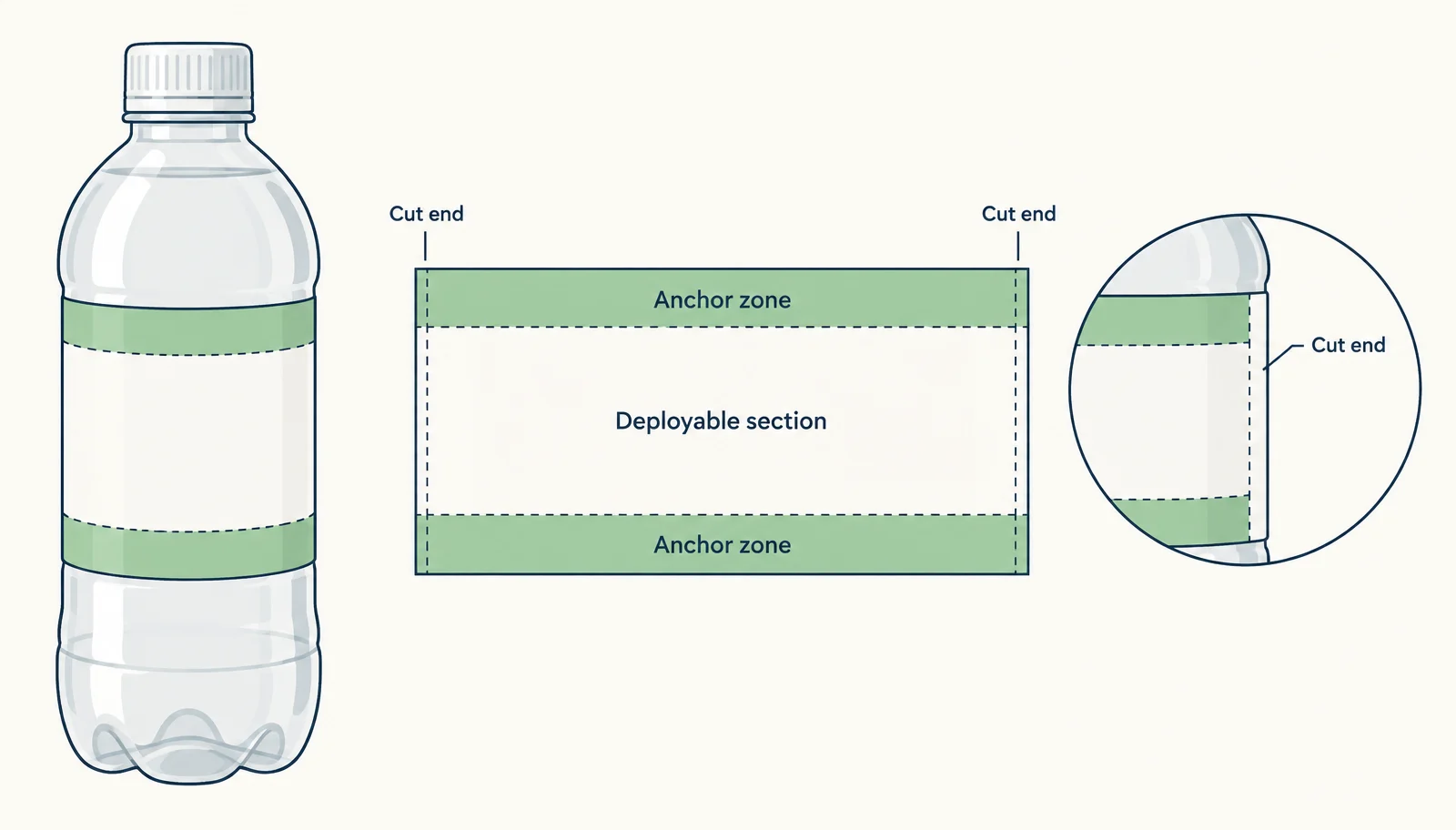
A deployed strap can become longer because its cut geometry unfolds. That is different from the polymer stretching. A design may use either mechanism or both.
Observe deployment before interpreting a tensile value. Record whether the strip opens cleanly, whether it stays tacky, and whether its material permanently lengthens. Do not use the difference between folded and deployed strap length as a measurement of material elongation.
If recovery is part of the design requirement, define how it will be measured after unloading. The word “stretchable” is not enough to specify acceptable recovery.
Where does the failure start?
The starting position is more useful than the description “the label broke.” Photograph it before removing or repositioning the damaged label. Record whether the problem appeared while opening, under sustained load, or during movement.
The table gives possible checks, not confirmed causes. More than one weakness can be present in the same assembly.
| Observed symptom | First checks | Evidence to retain | Useful next comparison |
|---|---|---|---|
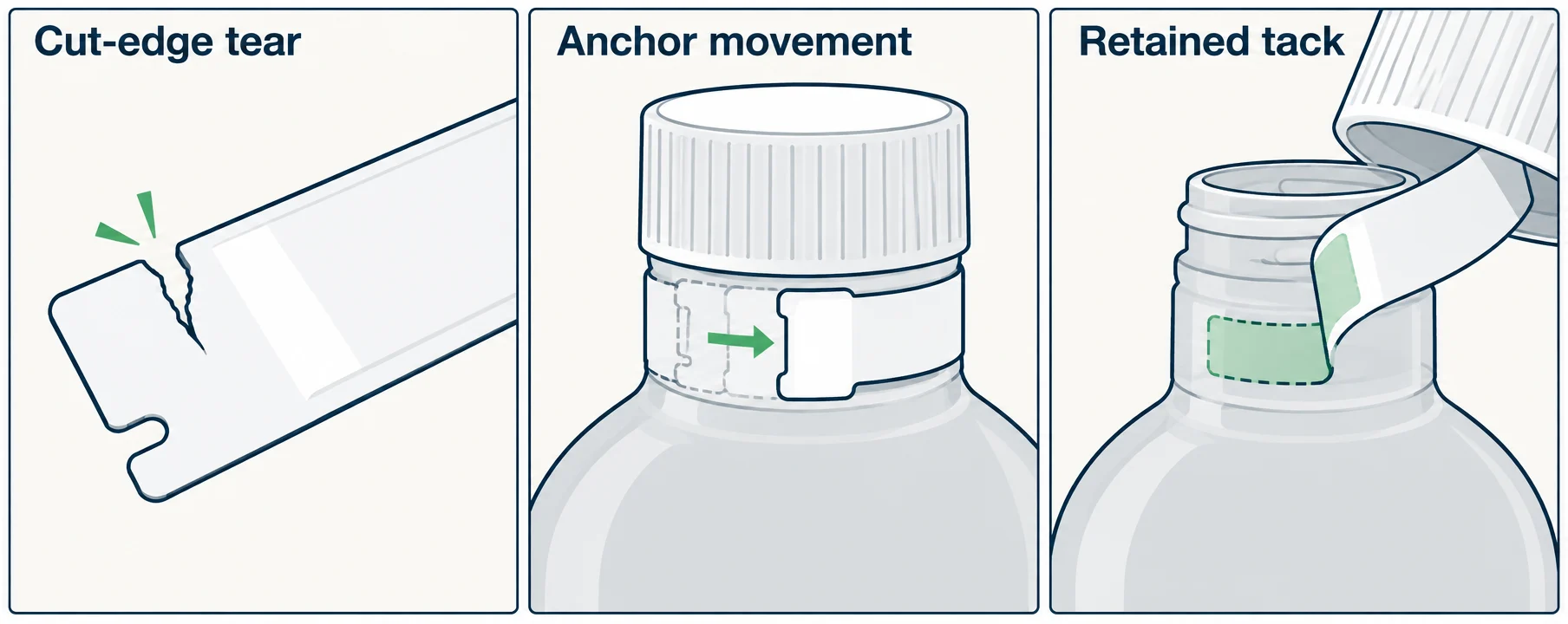
| Tear begins at a cut end or narrow section | Cut-edge damage, local geometry and direction relative to the web | Close-up of the starting point, drawing revision and MD/CD marking | Matched specimens with documented cut quality or a controlled geometry change |
| Strap gets longer without immediately tearing | Permanent deformation and the load history | Length before loading, after loading and after the defined recovery period | Same geometry and conditions with a documented film-grade comparison |
| Bonded anchor shifts or lifts | Bottle surface, bonded area, application conditions and pull direction | Anchor position before and after loading, bond-development time and surface condition | Same film and geometry with a controlled anchor or application comparison |
| Strap sticks during opening and then tears | Residual tack, deadener registration and incomplete cuts | Location of retained adhesive contact and the opening sequence | Opened specimens with verified non-tacky areas and consistent cut completion |
| Printed specimen behaves differently from unprinted stock | Ink, primer, varnish, lamination and cure or drying history | Exact layer sequence and photographs of the first visible damage | Matched converted specimens with and without the changed print layer |
Do not treat a scuff or an ink crack as proof that the film has failed. Locate the first structural damage and keep print observations in the record.
Why does a cut edge need its own check?
A cut strap is not the same specimen as an intact tensile strip. Examine cut ends, corners, narrow sections and accidental nicks. Their condition and geometry can affect where damage begins, so a favorable result on uncut stock is not enough.
Ask the testing laboratory which tear method fits the material and the question. ASTM D1938 concerns tear propagation using a defined specimen. A propagation result is not interchangeable with a tear-initiation result or the behavior of a complete die-cut strap.
Record machine direction (MD) and cross direction (CD) on the material and drawing. Do not assume either direction is always better. Keep the grade and conditions identifiable when comparing results.
For breaks occurring while removing waste on the press, use the separate label matrix stripping guide. That process problem needs different observations from a deployed strap failure.
Could the anchor be failing before the film?
Yes. A strap may remain intact while its bonded area moves or lifts. Check the anchor position rather than assuming the PE is too weak.
Initial tack, peel and sustained holding are different observations. Data from a standard surface can help screen an adhesive, but it does not establish behavior on the actual PET bottle. ASTM D3654/D3654M provides a shear-adhesion testing reference, not a complete carrying-use approval.
Record the bottle surface, anchor dimensions, application pressure and bond-development time. Separate temperature and moisture at application from those during service. Also record the direction in which the deployed strap pulls on the anchor.
If the label lifts before deployment or without carrying load, start with the broader pressure-sensitive label peeling guide. Review adhesive and liner options only after identifying the failure mode.
Will thicker PE or a higher-tack adhesive fix it?
Not automatically. Thickness is one input, not a qualification. A thicker film still needs evaluation with the same cut geometry, opening mechanism and print construction.
Likewise, higher initial tack cannot demonstrate sustained holding. If the film tears while the anchor remains in place, changing the adhesive is not a direct test of the film problem. If deployment is obstructed by residual tack, changing face thickness may leave the opening problem untouched.
Use the exact candidate grade, not just “soft PE” or “high elongation.” The PE film product page is a starting point for material inquiries, not evidence that a grade is qualified for this carrying application.
The release liner has a different job: it supports converting and release. It is removed before application, so a stronger PET liner does not reinforce the finished strap. Investigate liner damage when the problem occurs during converting, not as a substitute for testing the applied assembly.
How do you set up a useful comparison?
Start with a documented baseline that reproduces the observed problem. Keep a matched control in each comparison. Change a defined variable while recording the rest of the construction and process; verify interactions before approving the final assembly.
- Film comparison: keep the bottle, drawing, anchors and converting conditions matched; record the exact grade and direction.
- Cut-quality comparison: retain the same material and drawing while documenting the cutting change and resulting edges.
- Geometry comparison: identify the drawing revision and changed features instead of mixing different patterns in one result.
- Print-layer comparison: distinguish unprinted, printed and otherwise coated specimens, with the actual process recorded.
- Anchor comparison: keep the film and strap geometry matched while documenting the adhesive, bonded area or application variable being assessed.
Agree the load, duration, movement, environment and acceptance criteria with the packaging team before testing. Use controlled equipment and a safe test arrangement, not a person wearing an unqualified prototype. Material tests and bench comparisons do not replace the final package safety review.
Failure record template
This is a blank recording template, not a completed test report.
| Record field | Information to enter |
|---|---|
| Specimen identity | Film grade and lot, face thickness, adhesive, coatings and liner used during converting |
| Drawing | Revision, narrow sections, cut ends, anchor dimensions and MD/CD orientation |
| Converting history | Printer and ink, primer, deadener, cure or drying, cutting and winding conditions |
| Bottle and application | Bottle material and profile, surface condition, application method and bond-development time |
| Loading conditions | Actual load, loading direction, duration or movement sequence, and environment |
| Deployment | Opening sequence, residual tack, retained contact and incomplete cuts |
| First damage | Starting position, observed layer, timing and photographs |
| Deformation | Measurements before loading and after the defined unloading/recovery sequence |
| Comparison and decision | Matched control, changed variable, agreed acceptance criteria and result |
A result with one drawing, bottle and print process does not approve every version. Retain the records and repeat the relevant checks when the construction or use conditions change.
For the complete material and converting checklist, see material requirements for wearable bottle labels.
What should you send with a material inquiry?
Send the failure photographs, drawing revision, exact candidate construction and test conditions. Include a matched specimen description if you have already compared materials. This is more useful than asking for “stronger PE” without explaining where the label fails.
Request the current material datasheet and confirm which trial construction is available. A datasheet can support screening; it cannot supply missing evidence about your finished cut-and-bonded assembly.
Discuss PE Film Trial RequirementsTechnical references
- ASTM D882: tensile properties of thin plastic sheeting
- ASTM D1938: tear-propagation resistance of plastic film and thin sheeting
- ASTM D3654/D3654M: shear adhesion of pressure-sensitive tapes
These references identify separate material-test topics. They are not certificates, evidence of AllinLabel tests, or instructions for approving a finished bottle-strap label. Obtain the applicable method and agree a suitable test plan with the laboratory.
Frequently asked questions
- Is a higher elongation value always better for a bottle strap?
- No. The relevant question is whether the finished strap opens and behaves acceptably under its defined conditions. Elongation at break does not establish recovery, cut-edge resistance or anchor holding.
- Can I calculate a safe bottle weight from tensile strength alone?
- No. That calculation would omit the cut geometry, direction, deformation, anchors and service conditions. Establish acceptance criteria for the actual package and verify the complete assembly rather than publishing a weight rating from one film value.
- Does a tear test approve the final label design?
- No. A defined tear test characterizes its specimen under that method. It can help compare candidates, but the finished printed, cut and applied design still needs its own verification.
- Should I switch to PET film if PE tears?
- Not without identifying the failure. PET changes the material response and may change how the design opens and handles. Compare documented grades within the actual geometry instead of treating a polymer name as a solution.