
Application guide
Label Materials for Wearable Bottle Labels and Peel-Away Carry Straps
Plan film, adhesive zones, liner and converting trials for bottle labels that deploy into carrying straps — then qualify the printed, cut and applied assembly on the filled bottle.
Overview
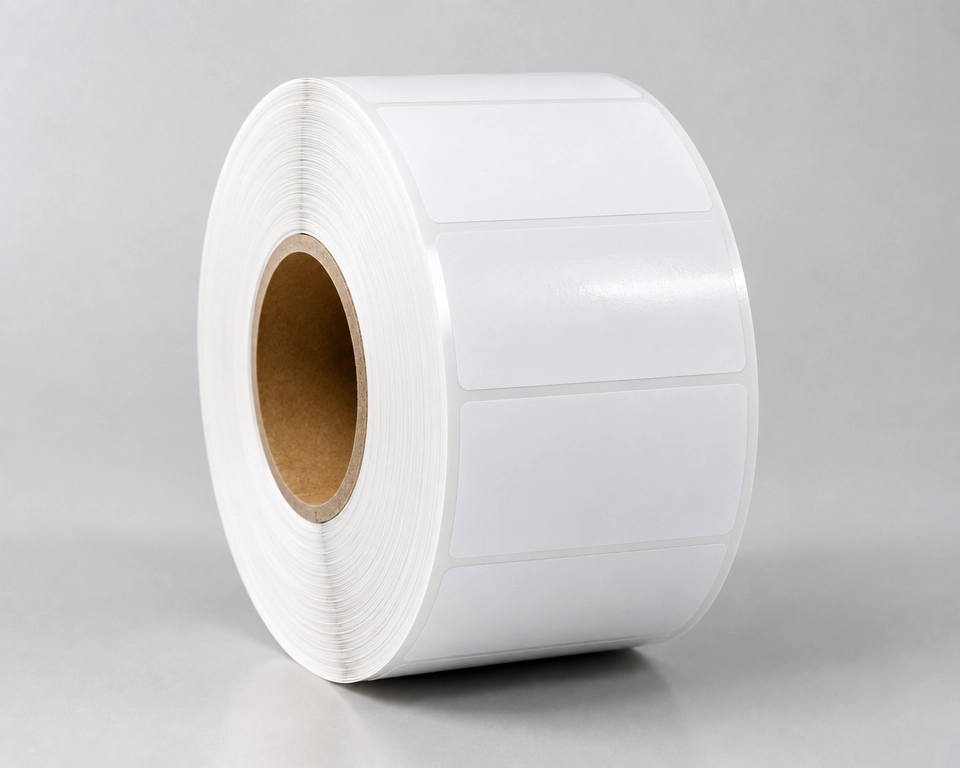
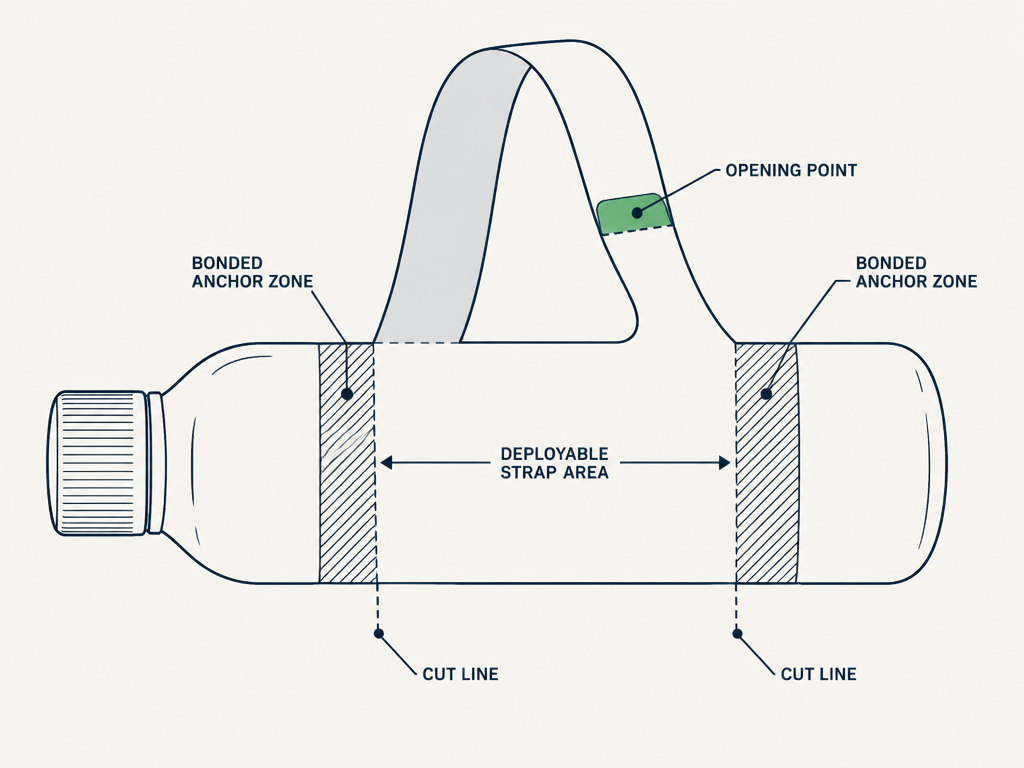
A wearable bottle label stays flat on a bottle until a cut-defined section is opened into a carrying strap. Selecting its label stock requires more than choosing a flexible film. The cut geometry, bonded anchor areas, printable surface and converting process all need to work together, then be evaluated on the filled bottle under the intended carrying conditions.
For converters developing this format, use the checks below to prepare a material request and a trial plan. A proposed laminate is development stock until the printed, cut and applied assembly has met the project's acceptance criteria.
Start with the strap drawing and the filled bottle
The load travels through the deployed film and into the areas bonded to the bottle. Review those areas before choosing a film thickness or adhesive family.
Show the narrowest strap section, cut ends, corners, anchor dimensions and machine direction on the drawing. Include the bottle profile and the intended carrying position. These details help distinguish a film-strength limitation from an anchor problem or a cut that starts a tear.
Also record whether the label is applied to a clean, dry bottle and later chilled, or applied when the bottle is already cold or wet. Application conditions and service conditions belong in separate fields.
For standard decorative labels without a carrying function, use Label Materials for PET Bottles.
Does the strap unfold, stretch, or do both?
A cut pattern can make a compact label unfold into a much longer strip. That change in geometry does not, by itself, require the polymer to stretch by the same amount.
If the design also relies on material stretch, ask for tensile behavior in both machine direction (MD) and cross direction (CD), including permanent deformation after loading. High elongation at break describes how far an intact specimen extends before failure. It does not establish elastic recovery or resistance to tearing from a die-cut edge.
The exact grade matters. Soft PE label film is a candidate to evaluate, but "squeezable" describes how a label follows a moving container. It does not qualify that film as a load-bearing shoulder strap. Review the PE film label stock options, then test the selected grade after printing and cutting.
Specify each part of the trial construction
The following is a specification worksheet, not a list of approved carry-strap constructions. Availability of the full combination must be confirmed for the proposed trial.
| Component | What to specify | What still needs evidence |
|---|---|---|
| Facestock | Polymer grade, color, face thickness, printable side and web direction | Tensile behavior, tear behavior at cut ends and permanent deformation after deployment |
| Bonded anchor zones | Adhesive grade, coat weight, anchor dimensions and bottle surface | Peel, sustained holding and movement of the anchor on the actual filled bottle |
| Deployable area | Required non-tacky area and the converter's deadener or another defined construction | Opening behavior, residual tack and registration against the bonded zones |
| Release liner | Liner material, thickness, release coating and release behavior | Cut consistency, web handling and removal during converting and application |
| Printable surface | Treatment or topcoat, printer model, ink and cure process | Ink adhesion and flexibility after the strap is deployed |
| Roll format | Web width, repeat, margins, core, outside diameter and winding direction | Fit with the intended printing, cutting and rewinding equipment |
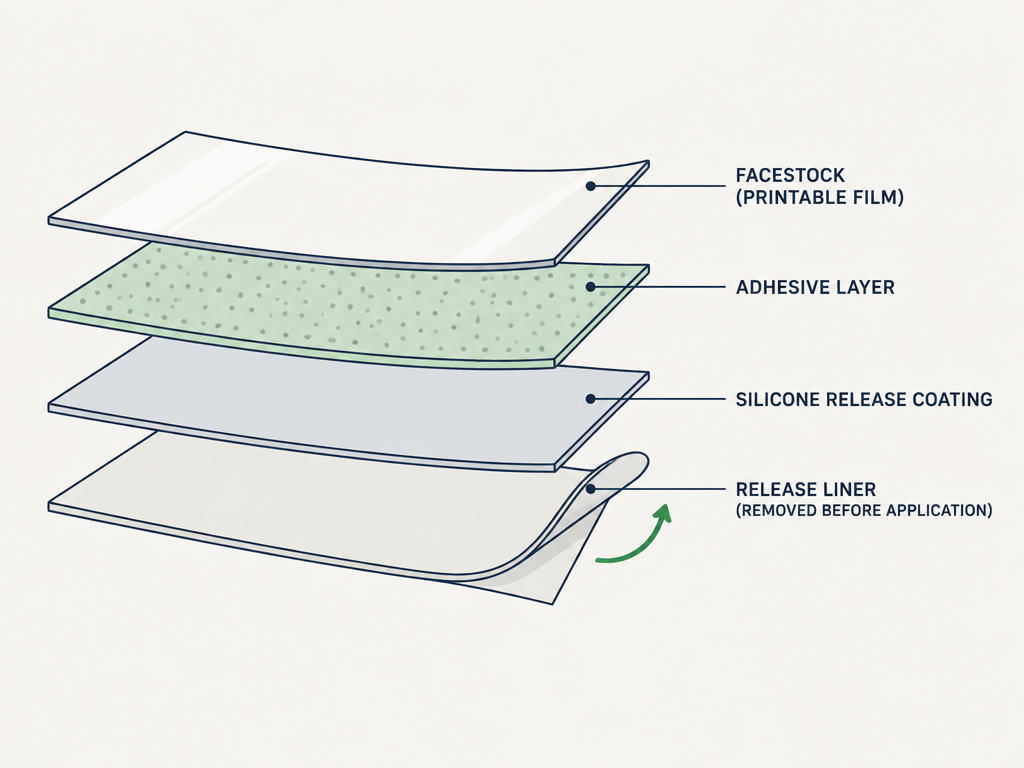
One candidate specification to discuss is a 100 µm white PE facestock with a permanent adhesive and a 30 µm PET release liner. These dimensions describe separate layers: the PE figure is face thickness, and the PET figure is liner thickness. Neither is the total laminate thickness. They are inputs for a trial request, not a rated or stocked carry-strap product specification.
The adhesive must hold the anchor, not just feel tacky
Initial tack, peel resistance and sustained holding describe different behavior. A permanent adhesive that bonds quickly may still allow movement under prolonged load or fail when the strap pulls at an angle.
Record the anchor area, bottle surface, application pressure, bond-development time, temperature and load direction. Compare the candidate adhesive on the actual PET bottle. Standard data on another test surface can help screen materials but cannot replace this assembly test.
Review adhesive and release liner options and request the current data for the proposed construction. Do not select a hotmelt grade only because it has high initial tack.
The liner supports converting; it does not carry the bottle
A PET liner can be considered where dimensional stability and a clean film backing are useful. It still needs to match the blade, cutting depth, laminate caliper and release requirement. No liner thickness makes a kiss cut immune to cutting through the backing.
The release liner is removed before the label is applied. Its thickness and strength therefore do not add to the final strap's carrying strength.
Plan the deployable area with the converter
Where an adhesive deadener is used, it changes the tack of selected adhesive areas so the strap can open. Keep its pattern aligned with the cut geometry and protected from the bonded anchors. A shifted pattern can leave the strap sticky or reduce the area carrying the bottle.
Use the deadener supplier's instructions for the exact adhesive, application and cure process. Check residual tack, coating adhesion and opening behavior after storage, as well as immediately after converting. The drawing and full converting sequence should define which areas remain bonded and which areas deploy.
Confirm the actual printer and ink system
"Digital inkjet" is not a complete film specification. UV inkjet and water-based inkjet can require different printable surfaces, primers and curing or drying conditions. Identify the printer and ink set before selecting the trial laminate.
Evaluate print adhesion and flexibility after the cut section is opened. Watch for cracking, flaking or distortion where the film bends or stretches. If varnish or lamination is part of the job, include it in the trial because it changes the finished construction.
Keep essential product information and the barcode readable after deployment. Include this check in the artwork review, rather than discovering it after the first printed run.
Qualify the converted label on the actual bottle
Use unprinted film tests to shortlist materials, then test the finished assembly. The plan below identifies what to record; it does not prescribe a universal load, number of cycles or carrying duration. Agree those conditions and acceptance criteria before starting.
| Trial stage | Specimen and conditions | Record | Decision supported |
|---|---|---|---|
| Film screening | Exact grade in MD and CD | Test method, thickness, deformation and failure mode | Whether the grade deserves a converting trial |
| Deployment | Printed and cut labels with the intended geometry | Opening effort, tears at cut ends, residual tack and usable strap length | Whether the strap opens as intended |
| Sustained load | Applied label on the filled bottle, with defined bond-development time | Load, duration, temperature, anchor movement and strap deformation | Whether time under load causes unacceptable movement |
| Movement | Same assembly under agreed carrying motions | Motion, cycles, anchor lift, cut-edge damage and failure position | Whether dynamic use exposes a weakness |
| Chilled or wet service | Bottle prepared as it will be in use | Application state, temperature, condensation and bond condition | Whether the intended moisture conditions change performance |
| Converting trial | Actual print, deadening, cutting and rewinding sequence | Registration, cut quality, liner damage and scrap | Whether the design can be made consistently |
| Finished-pack review | Deployed label and complete package | Print damage, readability, sharp edges, comfort and snag behavior | Whether the package is ready for a user trial |
Keep photographs of the failure position and identify the material lot. A tear at a cut end, a slipping anchor and an opening failure need different corrections.
A successful trial with one bottle, cut pattern and ink system does not automatically qualify a different version. Repeat the relevant checks when the construction, geometry or use conditions change. Bottle recyclability also needs a separate review of the complete label and the intended recycling stream.
Keep label count, square metres and roll length separate
This worked example is a format calculation, not a product offer. Assume a 280 mm-wide × 120 mm-long label, one lane across a 280 mm web, a 120 mm repeat, and no gaps, edge trim, setup waste or rejected labels.
Net area per label = 0.280 m × 0.120 m = 0.0336 m².
| Label count | Net label area | Web length under the stated assumptions |
|---|---|---|
| 10,000 | 336 m² | 1,200 m |
| 25,000 | 840 m² | 3,000 m |
Under these assumptions, 25,000 labels need 3,000 linear metres, not 3,000 square metres. Separately, a 280 mm-wide web contains 14 m² at 50 m and 28 m² at 100 m.
Real consumption changes when the web is wider than the label, the repeat includes a gap, or the process needs setup and waste allowance. State both the net label count and the requested roll dimensions. See label stock roll formats for the information needed in a material quotation.
Prepare a trial-material enquiry
Send the details below with your drawing:
- Bottle material, profile, fill volume and intended carrying position.
- Label drawing with anchor dimensions, narrowest strap width and web direction.
- Whether the strap unfolds only or also needs material stretch and recovery.
- Desired facestock grade and face thickness, adhesive and liner requirements.
- Printer model, ink system, deadener and converting sequence.
- Application surface condition and temperature, followed by the service conditions.
- Target load, carrying duration and the agreed test criteria.
- Web width, repeat, core, maximum outside diameter and winding direction.
- Required sample format, initial net label count and delivery destination.
Ask for the exact candidate construction and its current technical data. Small sheets can help screen printing and opening behavior; a representative roll is needed to evaluate the intended converting process. Sample format, charges, freight, lead time and production MOQ should be confirmed in the quotation.
Frequently asked questions
- Is 100 µm PE automatically suitable for a wearable bottle label?
- No. Face thickness alone does not establish carrying strength. The grade, cut geometry, print layers, anchors and use conditions must be tested together. A 100 µm PE grade can be discussed as a trial candidate without claiming it is qualified for the finished application.
- Does a PET liner make the finished strap stronger?
- No. The release liner supports processing and is removed before application. Final carrying behavior depends on the deployed face material, bonded anchors and the finished geometry.
- Can one film be approved for both UV and water-based inkjet?
- Only if the exact printable construction has been qualified with both systems. Identify each printer, ink and surface preparation process separately, then verify adhesion and flexibility after deployment.
- Can a normal decorative-label test approve this format?
- No. Decorative-label adhesion and print tests do not establish sustained or dynamic carrying performance. Add tests of the filled bottle and converted strap under defined use conditions.
Request trial material for your bottle-label design
Send AllinLabel your drawing, bottle details, printing process and roll requirements. Ask which material combinations and sample formats are available for your development trial, and confirm the exact construction before ordering.
Technical references
- Instron: tensile testing of thin plastic sheeting - background on film tensile characterization, not evidence of carry-strap qualification.
- ASTM D3654/D3654M: shear adhesion of pressure-sensitive tapes - method overview for sustained adhesive loading; finished-bottle conditions still need a project-specific test.
- Kustom Group: adhesive deadener technical information - historical manufacturer guidance on testing deadener compatibility with the actual stock. Obtain current product instructions before use.