
Food & Beverage
Food & beverage label materials
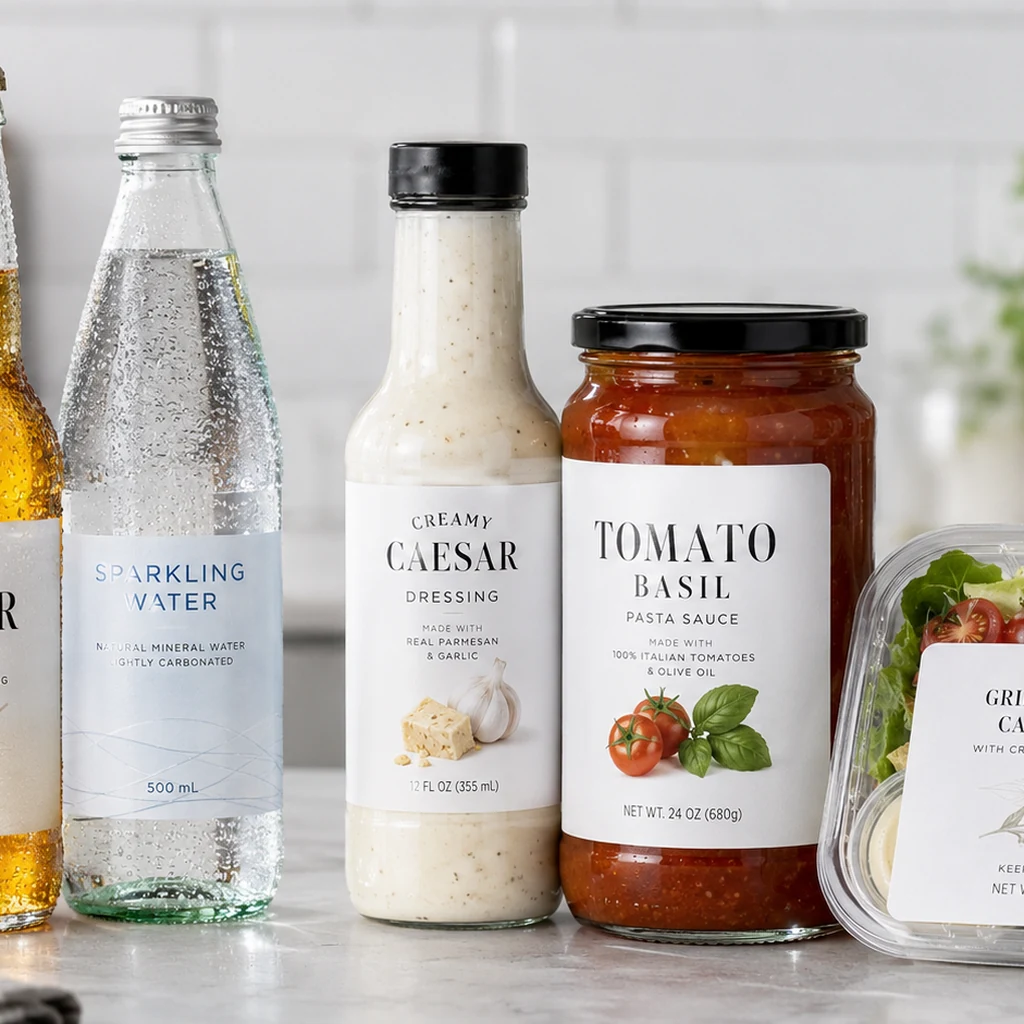
Beverage and food labels fail for three reasons: condensation on chilled glass, oil or grease migrating into the facestock, and pasteurisation cycles that soften an under-specified adhesive. We supply wet-strength papers, clear and white BOPP, and food-contact compliant adhesives that hold from the filling line to the ice bucket.
- −20°C
- Wet-apply minimum
- 72°C
- Pasteurisation tested
- 48h
- Sample dispatch
- 1600mm
- Max coating width
What the application demands
The failure modes we design against
- 01
Ice-bucket and condensation resistance
A chilled bottle pulls a film of water between the label and the glass. Wet-strength facestocks plus a wet-apply emulsion acrylic keep edges flat and the print legible after hours of immersion.
- 02
Grease, oil and steam in the pack area
Ready-meal trays and bakery film see hot fat and steam. Top-coated films and coated-back papers stop wicking and keep barcodes scannable through the shelf life.
- 03
Food-contact compliance for the whole construction
Adhesive, facestock and topcoat are supplied with declarations covering indirect food contact, so your customer's audit does not stop at the label.
- 04
No-label-look for premium SKUs
Clear BOPP on a clear PET liner gives the frosted-free, glass-like finish brand owners ask for, with dispensing speeds that suit high-cadence lines.
Recommended constructions
Facestock, adhesive and liner by application
| Application | Facestock | Adhesive | Liner | Spec sheet |
|---|---|---|---|---|
| Chilled PET / glass bottles, ice bucket | Clear BOPP 50 µm | Wet-apply acrylic emulsion | PET 23 µm | View → |
| Returnable glass, caustic wash | Wet-strength woodfree 80 g | Wash-off alkali-soluble | Glassine 60 g | View → |
| Dry goods, cartons, weigh-price | Semi-gloss paper 78 g | Permanent hot-melt | Glassine 60 g | View → |
| Frozen food, pack in freezer | White BOPP 50 µm | Freezer-grade acrylic | PET 23 µm | View → |
| Squeezable sauce bottles and tubes | PE film 85 µm | Permanent acrylic | PET 30 µm | View → |
Documents shipped with every food & beverage order
- Indirect food-contact declaration for adhesive and facestock
- Lot-level COA with coat weight and release value
- REACH / SVHC statement on request
- Migration test summaries for low-migration constructions
Materials used in this sector
Adhesive & liner guide →Converters and distributors can source the recommended constructions as request jumbo roll samples for slitting, printing and rewinding.
Frequently asked questions
Which adhesive should I use for bottles applied wet or chilled?
A wet-apply emulsion acrylic. It wets out through the surface moisture film on chilled glass and PET, then builds to a permanent bond as the interface dries. Standard hot-melt applied wet will tunnel or flag at the edges.
Do your food label materials pass pasteurisation and retort?
Our tunnel-pasteurisation constructions are tested to 72 °C for 30 minutes in water. Retort at 121 °C requires a PP or PET facestock with a dedicated retort adhesive — tell us the cycle and we will specify it.
Can you supply food-contact declarations?
Yes. Adhesive, facestock and topcoat declarations covering indirect food contact ship with the order, alongside a lot-level certificate of analysis.
What is the minimum order for a beverage material?
One pallet of jumbo roll for stock items, typically 2,000–3,000 m² depending on grade. Slit reels to your core and width are made from the same jumbo.
Other application programmes
Specify a beverage or food construction with our team
Send the container, the filling condition and the print process. We will nominate a construction, ship free samples within 48 hours and quote per square metre FOB Ningbo or Shanghai.