
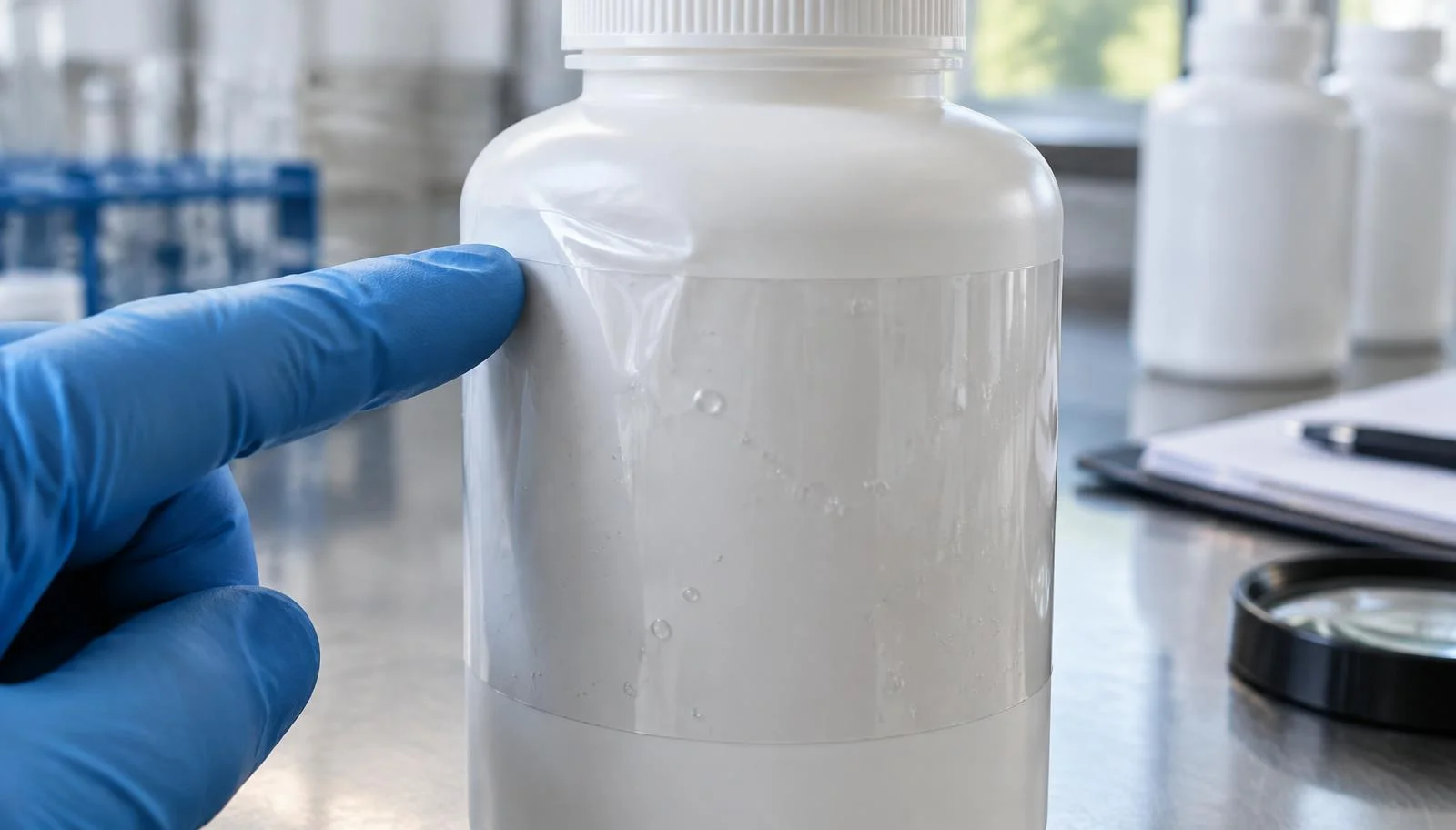
Bubbles, wrinkles and tunnels: what is the difference?
A bubble is a rounded pocket of air or gas under the label. A wrinkle is a crease in the facestock itself, usually running across a curve or taper. A tunnel is a raised, straight channel where the facestock has separated from the adhesive or liner, often running in the machine direction of the roll.
Timing matters as much as appearance. A defect visible straight off the applicator points to application or label-shape issues; one that appears hours or days later points to outgassing, adhesive flow, shrinkage or temperature change.
| What you see | When it appears | Most likely cause | Check first |
|---|---|---|---|
| Small, scattered bubbles | Immediately after labeling | Air trapped at application | Wipe-down pressure, brush or roller condition, label-to-surface angle |
| Bubbles that grow or appear later | Hours to days after filling | Gas released by the container (outgassing) | Container age before labeling; compare fresh vs aged containers |
| Creases on tapered or curved areas | Immediately | Label cannot conform to compound curve | Container shape, label size and position, facestock stiffness |
| Wrinkles after filling or squeezing | In use | Container moves more than the label can | Container deformation, facestock flexibility |
| Raised straight channels on the roll | Before application | Tunneling from roll or laminate stress | Unwind a fresh roll; inspect outer wraps vs core |
Why do labels bubble on plastic bottles?
Most bubbles on plastic bottles come from one of two sources: air trapped while the label is applied, or gas released by the container after labeling. Entrapped air shows up immediately; outgassing shows up later and is common on freshly blow-molded HDPE and some PE containers.
1. Air trapped at application
If the wipe-down brush, roller or pad does not press the label from the leading edge outwards, air is sealed in. Worn brushes, uneven pressure, a wrong label-to-container angle and high line speed all make this worse. Clear film labels make these bubbles easy to see.
2. Outgassing from the container
Some freshly molded plastic containers release gas for a period after molding. A film label with low gas permeability can trap that gas, forming bubbles that appear or grow after labeling. Comparing labels on fresh containers with labels on containers stored longer before labeling is the quickest way to confirm it.
3. Poor wetting of the surface
Low-surface-energy plastics, mold-release agents, dust or condensation can stop the adhesive flowing into full contact. The label then shows patchy contact or micro-bubbles that spread over time. Clean, dry surfaces and an adhesive suited to the substrate are both needed.
Why do labels wrinkle on bottles and containers?
Labels wrinkle when the facestock is asked to follow a shape it cannot. A flat label can wrap a simple cylinder, but it cannot lie flat on a surface that curves in two directions, such as a taper, shoulder or rounded oval panel.
- Compound curves: move the label to a straighter panel, reduce its height, or change the label shape.
- Stiff facestock: a stiffer film or paper resists conforming; a more flexible construction may follow the shape better.
- Squeezable containers: if the pack flexes in use, the label must move with it; see the squeezable-container guide.
- Misalignment: a label applied at an angle to the container axis will crease as it wraps.
What causes label tunneling?
Tunneling is a raised channel where the facestock lifts from the adhesive or liner, usually in long straight lines. It typically comes from a difference in how the facestock and liner react to tension, humidity or temperature, so one layer shrinks or expands relative to the other.
Common contributors are uneven unwind or rewind tension during converting, liners that absorb moisture and change dimension, and film facestocks that relax after slitting. Tunnels that appear on the roll before labeling should be reported with roll samples and storage conditions so the supplier can trace the construction.
Step-by-step troubleshooting checklist
- 1. Keep defective containers and note when the defect first appeared.
- 2. Separate immediate defects from delayed ones.
- 3. Inspect the applicator wipe-down: brush wear, pressure, angle and speed.
- 4. Compare containers labeled fresh from molding with aged containers.
- 5. Check the container surface for moisture, dust or release agents.
- 6. Confirm label position against the container's curves and tapers.
- 7. Unwind a fresh roll and check for tunneling before application.
- 8. Record storage temperature and humidity for rolls and containers.
- 9. Trial any material change on real filled containers before production.
What to send your label material supplier
Include photos and samples of failed labels, the container material and shape, when the defect appears, applicator type and line speed, storage conditions, and the current facestock, adhesive and liner construction. Always confirm final choices with the current TDS and a trial on your own containers.
Contact our technical teamFrequently asked questions
- Will bubbles under a clear label disappear on their own?
- Small entrapped-air bubbles sometimes reduce as the adhesive flows, but outgassing bubbles often grow. Find the cause rather than waiting.
- Why do labels only bubble on new HDPE bottles?
- Freshly molded containers can release gas after molding. Labeling them later or changing the construction can help; confirm with a side-by-side trial.
- Is wrinkling a material defect or a design problem?
- Usually a design and shape issue: the label is placed on a curve it cannot follow. Material flexibility can help, but placement and label shape matter first.
Labels bubbling or wrinkling on your containers?
Send us photos, samples and your container details and our engineers will help trace the cause.
If you are buying material before converting, start from request jumbo roll samples and then narrow the facestock, adhesive and liner with our technical team.
Related materials
Related reading
More guides on troubleshooting and related topics
 TroubleshootingWhy Labels Fail to Dispense and Liners Break on High-Speed ApplicatorsLabels that stay on the liner, fly past the product, or a liner that snaps mid-run usually trace back to release, die-strike, liner choice, tension or peel-plate setup.9 min read
 TroubleshootingWhy High-Elongation PE Film Can Still Tear in Bottle-Strap LabelsHigh elongation does not qualify a bottle-strap label. Learn how to separate cut-edge tears, permanent stretch and anchor movement before changing PE film.9 min read
 TroubleshootingWhy Does Ink Peel From BOPP, PE or PET Label Film?Separate wetting, intercoat adhesion, substrate anchorage and cure failures before changing film, ink or press settings.10 min read
Request a quote or a free sample
Send us your facestock, adhesive, liner and roll specification. Low MOQ, OEM/ODM, export to 60+ countries.