
Application guide
Label Materials for HDPE and PP Containers
Choose a pressure-sensitive label construction for HDPE bottles, PP jars, tubs, closures and semi-squeezable packaging. Compare the facestock, adhesive, liner and test conditions before ordering converter-ready rolls.
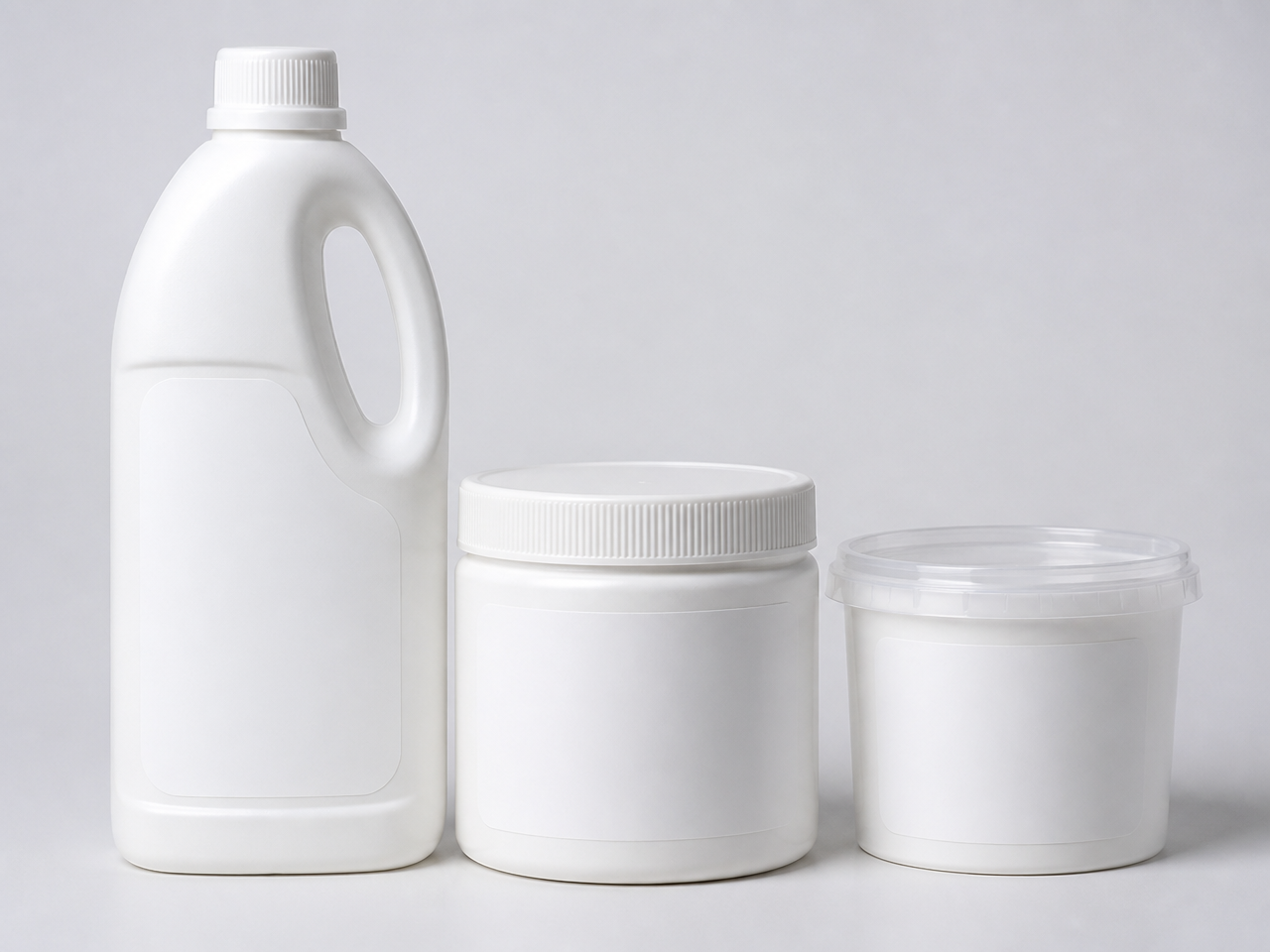
Quick answer: what label material works on HDPE and PP?
HDPE and PP are low-surface-energy plastics, so a label must do more than look suitable on the roll. Rigid bottles and tubs often start with white or clear BOPP, while containers that flex or squeeze may need a more conformable PE film. The adhesive must wet out the actual plastic surface, and the complete construction should be tested after filling, storage and handling.
- Use white BOPP when opacity, water resistance and a clean printed surface are priorities.
- Use clear BOPP for a no-label look on smooth, rigid or semi-rigid packaging.
- Consider PE film when the container flexes, squeezes or has a tight compound curve.
- Consider PET film when print durability, heat or chemical exposure matters more than conformability.
- Select the adhesive from the surface, application temperature, service conditions and required bond, not from the facestock name alone.
Start with the container, not the label name
Two containers carrying the same resin identification code can behave differently. Surface texture, mould-release residue, slip additives, recycled content, pigments, treatment and contamination can all change adhesive wet-out. The label panel, radius and squeeze behaviour add mechanical stress after application.
Before choosing material, record:
- 1Whether the container is HDPE or PP, rigid or squeezable, smooth or textured.
- 2Whether labels are applied before or after filling.
- 3The surface and room temperature during application.
- 4Exposure to water, condensation, oil, household chemicals, abrasion or sunlight.
- 5The required shelf life and whether the pack enters a defined recycling stream.
- 6The print process, die-cutting method, dispensing speed, roll direction and core size.
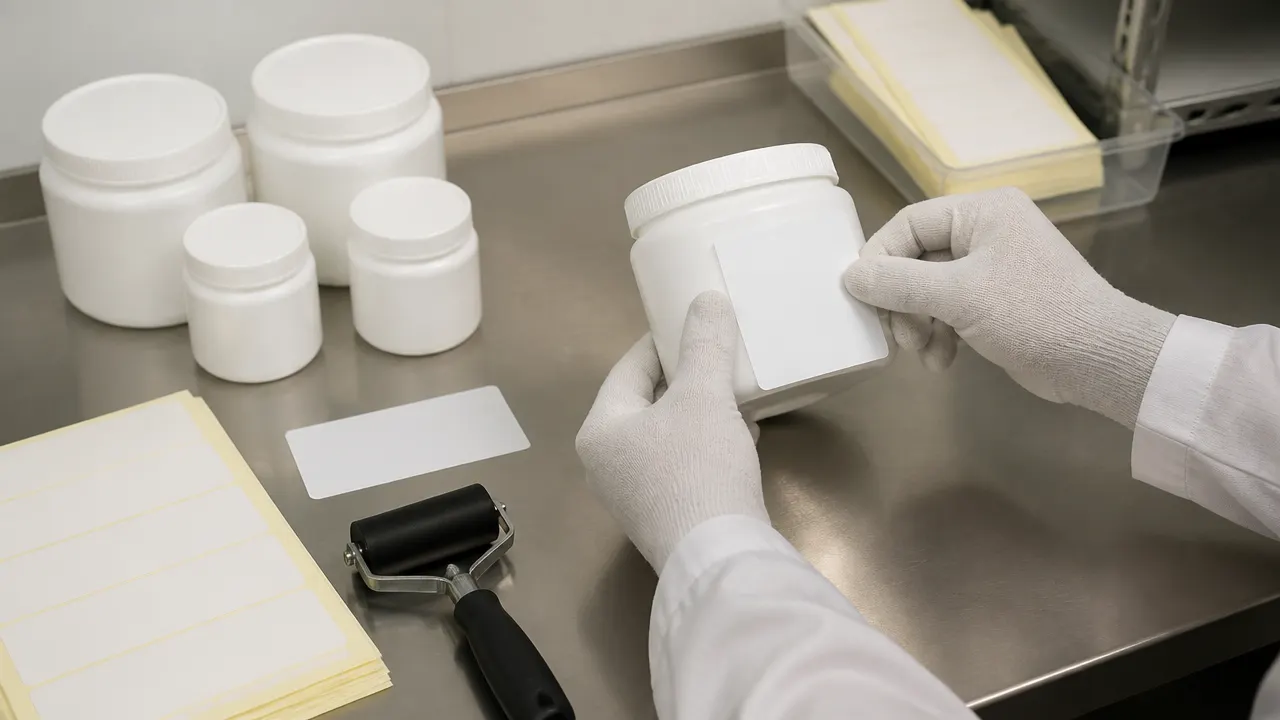
Starting constructions by container type
| Container and use | Facestock starting point | Adhesive requirement | What to validate |
|---|---|---|---|
| Rigid HDPE detergent or household bottle | White or clear BOPP | Permanent adhesive matched to low-surface-energy plastic | Initial wet-out, edge lift, moisture and product splash |
| Semi-squeezable HDPE personal-care bottle | Conformable BOPP or PE film | Permanent adhesive that maintains bond while the pack flexes | Squeeze recovery, label creasing and edge stress |
| Rigid PP jar, tub or closure | White or clear BOPP; PE where more conformability is needed | Adhesive validated on the exact PP surface | Curvature, overlap area, cold storage and handling |
| Fully squeezable tube or soft bottle | PE film | Flexible permanent adhesive with stable anchorage | Repeated squeeze cycles and print distortion |
| Clear container requiring a no-label look | Clear BOPP with a clear adhesive | Good wet-out and optical clarity on the actual surface | Haze, bubbles, dust, moisture and label-panel smoothness |
| Harsh industrial HDPE or PP container | PET, durable PP or vinyl, depending on exposure | High-performance construction selected for the named chemicals and surface | Chemical splash, abrasion, outdoor exposure and barcode durability |
This table is a shortlist, not a product specification. The correct roll must be confirmed with the exact container, label geometry and filling-line conditions.
Why labels lift from HDPE and PP
Pressure-sensitive adhesives need intimate contact with the surface before the bond can build. HDPE and PP resist adhesive wet-out more than higher-energy surfaces such as glass or PET. A label may appear secure immediately after application and then lift when stored, squeezed or exposed to moisture.
Common causes include:
- an adhesive that is not suited to the actual plastic surface;
- mould-release residue, oil, dust or condensation on the label panel;
- insufficient wipe-down pressure during automatic application;
- labelling below the adhesive's minimum application temperature;
- a stiff facestock on a curved or squeezable container;
- a label that extends beyond the designed label panel;
- filling, capping or packing before the bond has had time to develop;
- product ingredients or cleaners migrating to the label edge.
If the label already peels, use the pressure-sensitive label peel-off troubleshooting guide to separate a material problem from a surface, geometry or application problem.
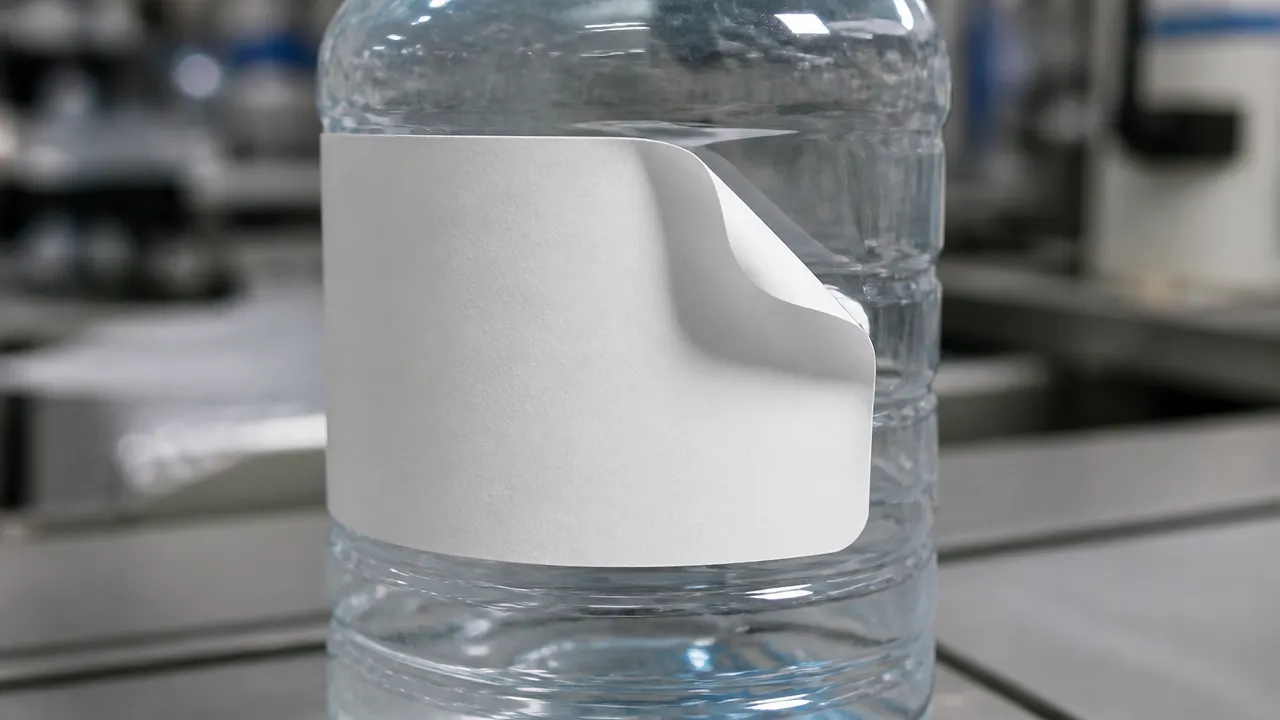
Choose the facestock around container movement
White BOPP for opaque, moisture-resistant labels
White BOPP gives a bright printable surface and hides the container colour. It is a practical starting point for rigid and semi-rigid HDPE or PP bottles where water resistance and consistent converting matter. It still needs to be checked on tight curves and containers that deform during use.
Related material: White BOPP label material.
Clear BOPP for no-label-look packaging
Clear BOPP can make graphics appear printed directly on the container. The result depends on more than film clarity: the adhesive must wet out evenly, and dust, moisture, texture or moulding marks can remain visible beneath the label. Approve the construction on production containers, not a flat laboratory panel.
Related material: Clear BOPP label material.
PE film for squeezable and contoured packs
PE film is more conformable than a stiff film and can move with shampoo bottles, personal-care packs and squeeze containers. Test the printed and converted label through repeated squeeze and recovery cycles. A conformable facestock cannot compensate for the wrong adhesive or an oversized label.
Related material: PE label material.
PET film for demanding durability
PET film is a useful starting point where the label must resist abrasion, heat, oil or named chemicals. It is stiffer than PE and may not suit a highly squeezable container or a tight compound curve. For drums, jerrycans and harsh outdoor use, continue to the chemical and industrial label material page.
Related material: PET label material.
For drums, jerrycans and harsh outdoor exposure, continue to chemical and industrial label material.
Match the adhesive to the surface and service conditions
Do not specify an adhesive only as “permanent” or “high tack.” The same chemistry can behave differently when the plastic, coat weight, facestock and test method change.
For a smooth rigid package, begin with a permanent adhesive developed for low-surface-energy plastics. For a textured surface or a project that needs stronger initial grab, a high-tack construction may be a better trial. Where the package faces heat, ultraviolet light, oil, cleaners or repeated flexing, check both immediate adhesion and aged performance.
Keep application temperature separate from service temperature. The first describes the conditions when the label is applied. The second describes the conditions the bonded label faces later. A label that survives cold storage may still fail if it was applied to a cold, wet container.
Use the acrylic vs hotmelt label adhesive comparison to understand the trade-offs, then confirm the final construction by sample testing.
Do not treat the release liner as an afterthought
The liner affects die-cutting, matrix stripping, roll stability, label release and automatic dispensing. Glassine is common for general converting. PET liner can provide a thinner, dimensionally stable carrier for small labels or demanding dispensing, while heavier paper liners may suit other converting formats.
Select the liner after confirming label size, die-cut geometry, release requirement, applicator sensor and line speed. No liner type is automatically best for every HDPE or PP package.
Related guide: label adhesives and release liners.
Test the complete label on production containers
A useful trial changes one variable at a time and records the result. Ask for sample rolls made close enough to the intended construction to reproduce the facestock, adhesive, liner and roll format.
- 1Collect containers from the real moulding and filling supply chain, including normal batch variation.
- 2Record resin, colour, recycled content if known, surface treatment, texture and any mould-release or cleaning process.
- 3Apply labels at the lowest planned application temperature using the intended applicator pressure and speed.
- 4Inspect initial wet-out, bubbles, wrinkles and edge contact.
- 5Recheck after the agreed dwell period and after filling, capping and packing.
- 6Condition samples through the real moisture, cold, heat, squeeze, abrasion or chemical exposure.
- 7Record edge lift, label movement, adhesive residue, facestock distortion and print readability.
- 8If recyclability is part of the brief, test the complete labelled package under the current protocol for the target HDPE or PP stream.
Keep the container batch, label roll, application settings, conditioning time and acceptance criteria with the trial record. A pass on one clean bottle is not enough evidence for a production release.
Request HDPE / PP Material SamplesRecycling compatibility must be verified by packaging stream
A label does not make an HDPE or PP package recyclable by itself. Compatibility depends on the container colour and format, label facestock, adhesive, ink, label coverage and the recycling system used in the destination market.
Where recycling is a project requirement, identify the target stream before selecting the construction. Use the current design-for-recycling guideline and test protocol for that stream. Do not transfer a result from PET bottles to HDPE or PP, and do not describe an untested AllinLabel construction as certified or approved.
Related reading: how to test wash-off labels for PET, HDPE and glass packaging and recyclable-compatible label materials.
What to send with an HDPE or PP material enquiry
Send enough detail for the first sample to answer a real question:
- container resin: HDPE or PP;
- rigid, semi-squeezable or fully squeezable format;
- a production container or clear photos of the label panel;
- surface texture, treatment and known additives or contamination;
- label dimensions, shape and corner radius;
- white, clear, metallic or other appearance;
- printing method, ink or ribbon and any topcoat requirement;
- application temperature and service temperature;
- exposure to water, oil, chemicals, abrasion or outdoor conditions;
- roll width, core size, winding direction and required liner;
- expected order format and annual volume;
- recycling or compliance requirement, with the named protocol if available.
For converter-ready supply, review label stock jumbo rolls before sending the roll specification.
Frequently asked questions
- What is the best label material for an HDPE bottle?
- White or clear BOPP is a practical starting point for a rigid HDPE bottle. A semi-squeezable bottle may need a more conformable BOPP or PE facestock. The adhesive must be validated on the actual HDPE surface because texture, treatment, additives and contamination can change adhesion.
- Do standard permanent labels stick to polypropylene?
- Some permanent constructions can work on smooth PP, but the word "permanent" does not prove suitability for a low-surface-energy plastic. Test the complete construction on the actual PP container at the intended application temperature and after the required dwell and conditioning.
- Is BOPP or PE better for a squeezable container?
- PE is usually the better starting point for a fully squeezable or tightly contoured container because it is more conformable. BOPP can suit rigid and semi-squeezable packs where print appearance, opacity or clarity is the priority. Container shape and repeated flexing should decide the trial.
- Why does a clear label look cloudy on an HDPE or PP bottle?
- Cloudiness can come from incomplete adhesive wet-out, surface texture, dust, moisture, moulding marks or a mismatch between the clear facestock and adhesive. Approve a clear construction on production containers under the lighting used for pack inspection.
- Should HDPE and PP packages use a wash-off adhesive?
- Only when the selected recycling guideline or packaging brief requires a releasable construction. HDPE, PP and PET streams do not use one universal test. Confirm the destination stream and test the complete labelled package before making a recycling claim.
- What sample should a converter request?
- Request the proposed facestock, adhesive and liner in a format that can be printed, die-cut and dispensed on the intended equipment. Include production containers and the application conditions so the trial tests the real failure risks rather than adhesion to a generic plastic panel.
Specify the construction, then test it
Send the container, label geometry, printing method, exposure and roll requirements. AllinLabel can propose a starting construction for your own converting and application trial. Final suitability remains subject to testing on the actual HDPE or PP package.
Request a quote or a free sample
Send us your facestock, adhesive, liner and roll specification. Low MOQ, OEM/ODM, export to 60+ countries.