
What is the difference between clear, white and metallized BOPP label material?
Clear, white and metallized BOPP label materials differ mainly in appearance. AllinLabel white BOPP gives an opaque base for full-color artwork. AllinLabel clear BOPP lets the container show through around the print. AllinLabel silver metallized BOPP adds a metallic surface. All three are waterproof, tear-resistant film faces, so the look usually decides first.
| White BOPP | Clear BOPP | Silver metallized BOPP | |
|---|---|---|---|
| Look | Opaque white, top-coated | Transparent, for a no-label look | Vacuum-metallized silver, bright or matte |
| Standard face (typical) | 50 µm, 46 g/m² | 40 µm, 36 g/m² | 55 µm, 50 g/m² |
| Published face range | 50 / 60 / 70 / 80 µm (product page) | 30–50 µm (data sheet) | 50–60 µm (product page) |
| Standard liner (typical) | White glassine, 55 µm | PET film, 23 µm | White glassine, 55 µm |
| Data sheet | AL-WBOPP-50-P-GL | AL-CBOPP-40-P-PET | AL-SBOPP-55-P-GL |
Rows marked (typical) show typical values from AllinLabel data sheets, version 1.0, issued 2026-08-04. Thickness by ISO 534; grammage by ISO 536. They are laboratory values, not a specification. The range row lists available thicknesses from the marked source, not test values.
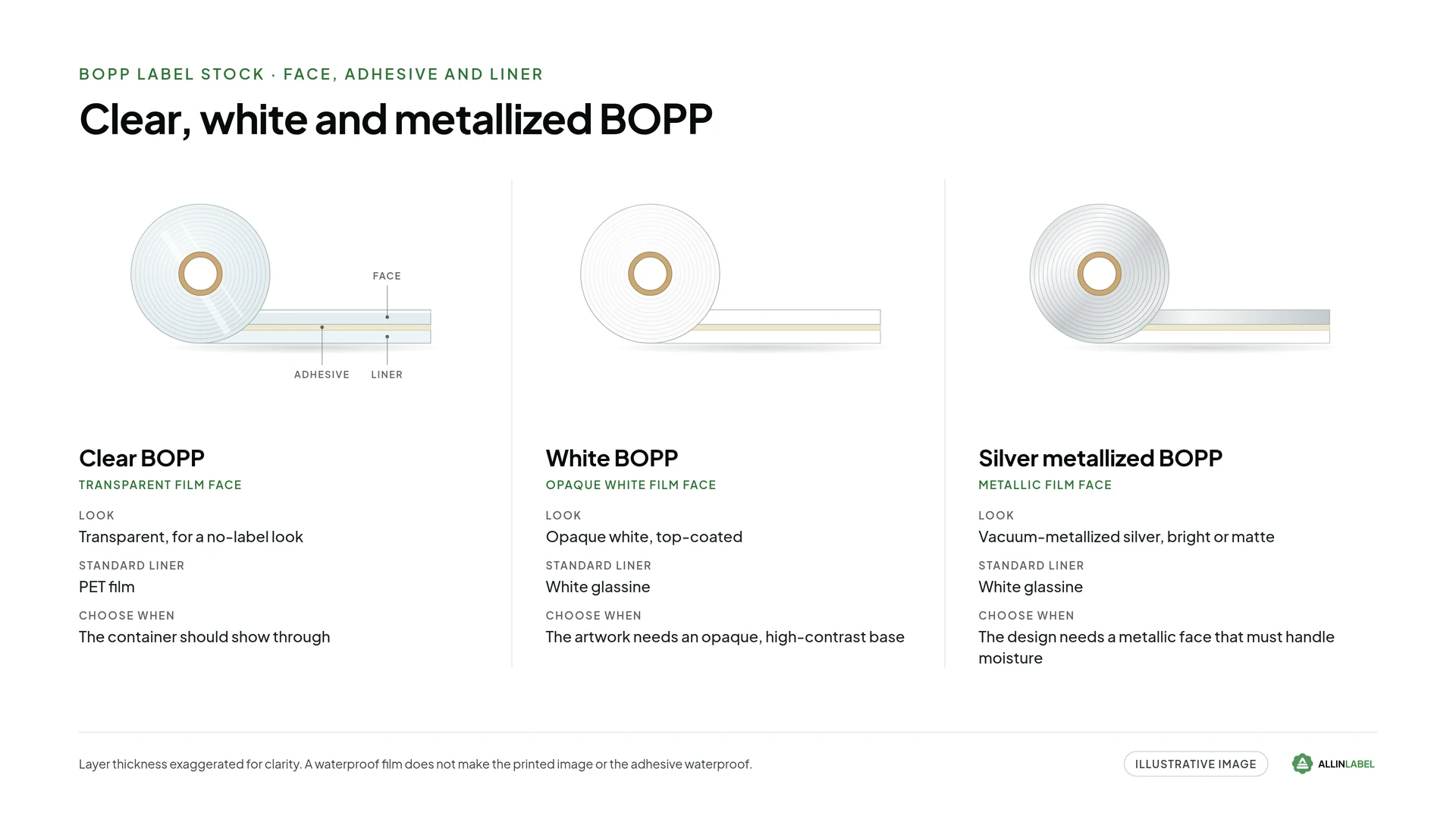
Choose white BOPP when the artwork needs an opaque, high-contrast base. Choose clear BOPP when the container should show through. Choose silver metallized BOPP when the design needs a metallic face that must handle moisture. Full details are on the white BOPP label material, clear BOPP label material and silver metallized BOPP label material pages.
What do people mean by "BOPP labels"?
"BOPP labels" can mean two things in purchasing. Some buyers mean finished, printed and die-cut labels. Others mean BOPP label material: the facestock, adhesive and liner supplied on rolls for printing and converting. AllinLabel supplies the second, as jumbo or slit rolls, to converters and label printers who make the finished labels.
Say which one you need in an inquiry. Converters specify face, adhesive, liner, roll width and core. See how AllinLabel supplies label stock jumbo rolls.
When should I choose BOPP instead of PET label material?
Choose BOPP label material for clear, white or metallized packaging labels where moisture resistance, shelf appearance and cost control matter. Choose PET label material when the label faces higher heat, solvents, harsh chemicals, abrasion or a long service life. BOPP suits many packaging uses but is not the first choice for high heat.
The BOPP vs PET label material comparison sets out both films by container, print method and exposure. For squeeze tubes or very soft bottles, compare PE film instead. Do not choose PET only because it sounds stronger.
How do print process, adhesive and liner affect the choice?
The print process, adhesive and liner can rule out a BOPP grade even when the look is right. AllinLabel BOPP data sheets list compatible print processes for each grade. The adhesive must suit the container surface and temperature. The liner must suit die-cutting and dispensing. Choose the three layers as one construction.
| Print process (data sheet §7) | White BOPP | Clear BOPP | Silver metallized BOPP |
|---|---|---|---|
| UV flexo, water-based and solvent flexo | Listed | Listed | Listed |
| Offset, screen, UV inkjet | Listed | Listed | Listed |
| Letterpress | Listed | Not listed | Not listed |
| HP Indigo | With a compatible primer | With a compatible primer | With a compatible primer |
| Thermal transfer | TT-coated grade, resin ribbon | TT-coated grade, resin ribbon | TT-coated grade, resin ribbon |
Pre-test inks, varnishes and process conditions before production. The standard adhesive on all three data sheets is a permanent water-based acrylic. Its typical minimum application temperature is +5 °C, and its typical service range is −20 °C to +80 °C. For deep-freeze, wash-off or high-tack needs, ask for the matching variant. In the standard constructions, the clear grade uses a PET film release liner; white and silver use glassine.
When is BOPP the wrong label material?
BOPP is the wrong label material when the container flexes hard or the label faces high heat or harsh chemicals. The AllinLabel white BOPP data sheet recommends rigid and semi-rigid containers with flat or moderately curved surfaces. A waterproof film also does not make the printed image or the adhesive waterproof.
- Squeeze bottles and soft tubes: compare PE film.
- High heat, solvents or long service life: compare PET.
- A clear label that must be invisible in every condition: adhesive, trapped air and container texture can still show the label area.
What else do converters ask about BOPP label material?
Three practical questions come up before a BOPP trial: whether BOPP is waterproof, whether clear or metallized BOPP needs white ink, and where to find data sheets. The short answers below follow current AllinLabel product pages and data sheets. Confirm details for your grade before you approve artwork.
Is BOPP label material waterproof?
The BOPP film absorbs no water, so it does not swell or wrinkle when wet. Full waterproof performance also depends on the adhesive, the inks and the container. For immersion, condensation or wash-down, ask for a water-resistant permanent acrylic and test the printed label on the filled pack.
Do clear and metallized BOPP need white ink?
Yes, where the artwork must look opaque. White ink can provide a background behind selected graphics on clear or metallized BOPP. Its coverage and opacity belong in the artwork and press trial; choosing the film does not set them. Mark white-ink areas in the artwork.
Where can I see BOPP data sheets?
AllinLabel publishes technical data sheets for its white, clear and silver metallized BOPP grades as PDFs on each product page. White BOPP also has an HTML white BOPP technical data sheet. All values are typical values for guidance, so test on your own press and containers.
How do I request BOPP label material samples or a quote?
To request AllinLabel BOPP label material samples or a quote, send the look you need, print process, container surface, exposure, adhesive needs and roll specification. Use the quote form or email sales@allinlabel.com. Free samples; you cover freight. Generally 15–30 days, depending on the product. Technical questions go to tech@allinlabel.com.
Request a quote or free samples · Browse all film label materials
About the author. Gavin Gao is Marketing Manager at AllinLabel (Wenzhou All-In Packaging Technology Co., Ltd., founded in 2016), which supplies self-adhesive label material rolls to converters and printers.