
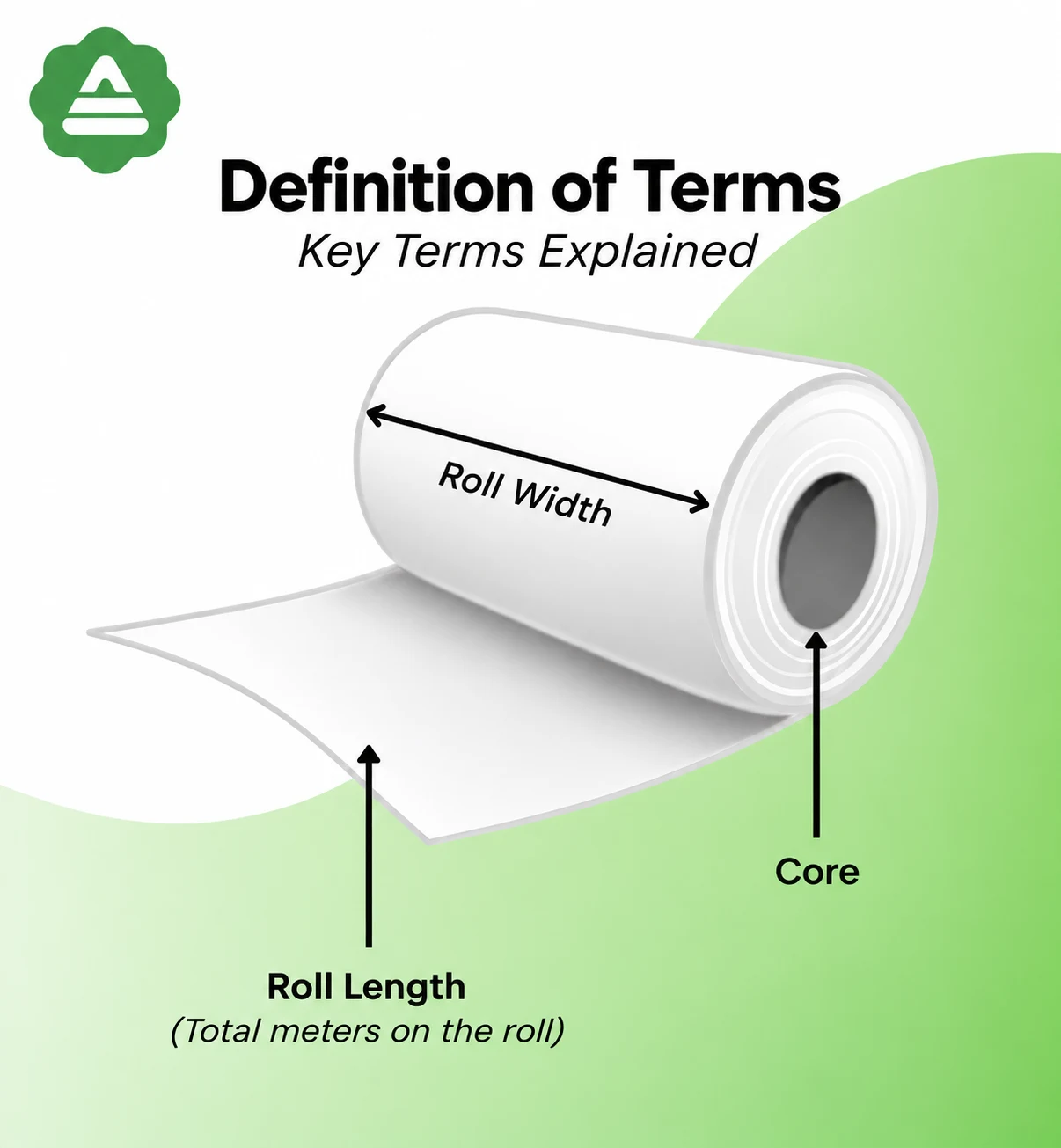
What each quotation unit measures
| Unit on the quote | What it measures | What you need to compare it |
|---|---|---|
| MSF | 1,000 square feet of material area | Price per MSF and confirmation of the billed area basis |
| Square meter, m² or sqm | Material area | Price per m² and confirmation of the billed area basis |
| Linear meter, LM or running meter | Length along the roll | Price per linear meter and roll width |
| Roll | One physical roll | Price, width and material length per roll |
In paper purchasing, the M in MSF denotes one thousand. MSF is an area unit, not a roll length. Case Paper's MSI/MSF calculator explains this convention.
For a lined, self-adhesive construction, the layers share the same web footprint. Do not add the facestock area, adhesive area and liner area together to calculate the purchased roll area. First confirm whether the quote covers the complete laminate or only a component such as uncoated facestock film.
Also ask whether billing uses the supplied slit-roll area or another agreed basis that includes charged trim or production allowances. Unit conversion cannot resolve an unclear billing basis.
The conversion formulas
Use meters for both width and length in the following calculations. Divide a width in millimeters by 1,000 first.
| To calculate | Formula |
|---|---|
| Roll area in m² | Width in meters × material length in meters |
| USD/m² from USD/MSF | Price per MSF ÷ 92.90304 |
| USD/MSF from USD/m² | Price per m² × 92.90304 |
| USD/m² from USD/linear meter | Price per linear meter ÷ width in meters |
| USD/linear meter from USD/m² | Price per m² × width in meters |
| USD/m² from a roll price | Roll price ÷ roll area in m² |
| Material cost from an area price | Purchased area in m² × price per m² |
These equations work with other currencies too, provided all compared prices have first been put into the same currency using a stated exchange rate and date.
The area conversion uses the international foot. NIST lists one square foot as 0.09290304 m²; multiplying by 1,000 gives 1 MSF = 92.90304 m². Keep that factor in the calculation rather than rounding it to 93. NIST conversion factors.
Quantity and price conversions run in opposite directions:
- To convert an area quantity from MSF to m², multiply by 92.90304.
- To convert a unit price from USD/MSF to USD/m², divide by 92.90304.
Example: calculate the area of one roll
A hypothetical roll is 330 mm wide and contains 1,000 m of material.
Width = 330 / 1,000 = 0.330 m
Area = 0.330 × 1,000 = 330 m²
Area in MSF = 330 / 92.90304 = approximately 3.55209 MSF
The roll contains 330 m², not 1,000 m². A longer roll does not tell you its area unless you also know its width. For multiple roll sizes, calculate each width-and-length group separately, then add their areas.
Three quotes compared on the same basis
Suppose three hypothetical quotes cover the same agreed construction and a purchase of 330 m². For the linear-meter quote, the roll is 330 mm wide and 1,000 m long. All prices are USD, and all exclude freight, taxes, packing and separately billed converting charges.
| Hypothetical quote | Original price | Conversion to USD/m² | USD/m², rounded | Material cost for 330 m² |
|---|---|---|---|---|
| A | USD 80.00/MSF | 80 ÷ 92.90304 | 0.8611 | USD 284.17 |
| B | USD 0.27/linear meter at 330 mm | 0.27 ÷ 0.330 | 0.8182 | USD 270.00 |
| C | USD 0.84/m² | Already area-based | 0.8400 | USD 277.20 |
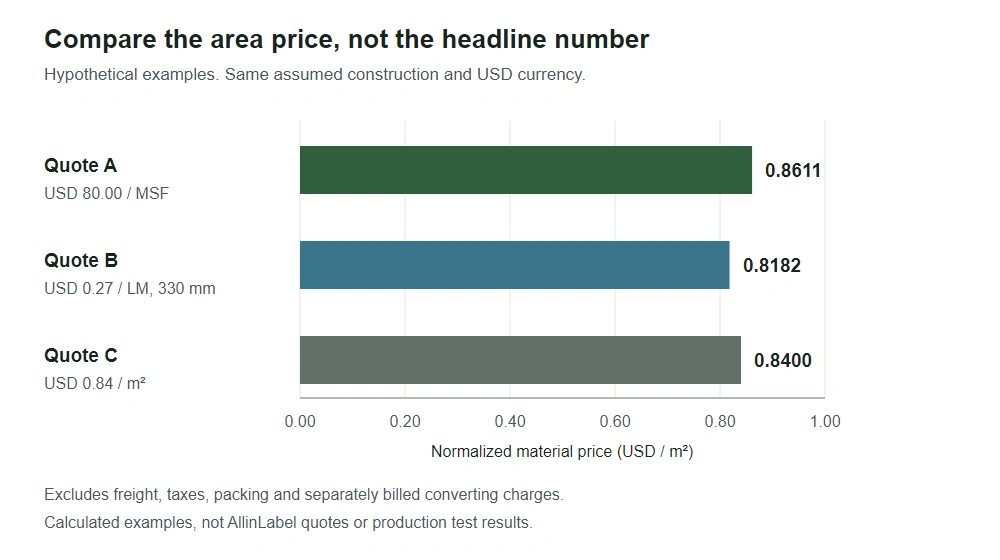
Download the hypothetical quote comparison data (CSV)
On these assumptions, B has the lowest material cost. Its original number, 0.27, did not establish that result: the width and unit conversion did.
Do not multiply the rounded chart value by the order area to reconstruct an invoice. Retain full precision during calculation and apply the agreed rounding rules at the end.
Why roll width changes the comparison
Consider two separate hypothetical offers:
| Offer | Price per linear meter | Width | Price per m² |
|---|---|---|---|
| Narrower roll | USD 0.27 | 330 mm | USD 0.8182 |
| Wider roll | USD 0.30 | 400 mm | USD 0.7500 |
The wider roll costs more per meter of length but less per square meter. It is not necessarily the better purchase. If the wider web cannot run on your press, or needs another slitting operation with unsaleable trim, that lower area price may not produce a lower job cost.
Use the quoted supply width to normalize the purchase price. Evaluate press-compatible width, trim and label layout separately. Do not divide by the finished label width unless that is also the width of the purchased material.
A price per linear meter without a width is incomplete for comparison. Ask the supplier to state both on the quotation.
Check the material before comparing its price
Two quotes described as “white BOPP” may cover different constructions. An area conversion does not make them technical substitutes.
| Item | What to match or confirm |
|---|---|
| Facestock | Material grade, finish, thickness or basis weight, and any print-receptive coating |
| Adhesive | Specified grade, intended surface and application conditions, with relevant performance requirements |
| Release liner | Paper or film type, thickness or basis weight, and release requirements |
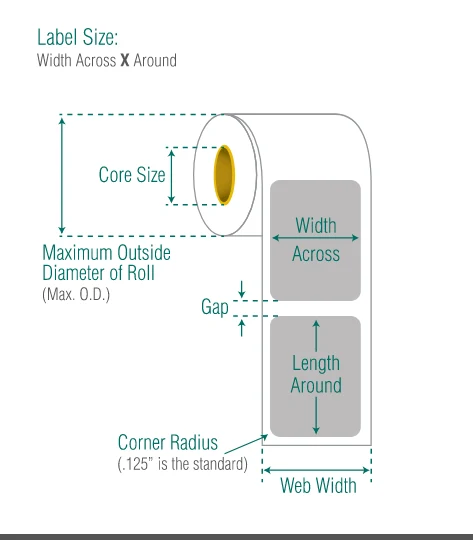
| Supply format | Width, material length, core, outer diameter limits, unwind requirements and agreed tolerances |
| Quantity | Comparable order volume and whether minimum billing or production allowances apply |
| Cost scope | Included slitting, packing and other services, plus clearly separated transport and destination charges |
Read the label material datasheet alongside the quote. A matching material family name is not enough; the relevant construction and test conditions need to support the same job.
If one offer is for bare film and another includes adhesive and liner, mark them not directly comparable. Do not rank them as equivalent materials merely because both have been converted to USD/m².
For supply-format questions, use the label stock jumbo rolls page. Confirm the available format for the actual construction rather than assuming an example width in this article is an AllinLabel supply specification.
From purchased area to usable output
Purchased square meters include material that may not become saleable labels. Edge trim, gaps, the waste matrix, setup material and rejected output affect how much stock a job consumes.
For a completed job, a useful check is:
Material cost per 1,000 accepted labels
= Total stock cost allocated to the job / accepted label count × 1,000
If a hypothetical job consumes USD 270 of stock and produces 80,000 accepted labels, the material cost is:
270 / 80,000 × 1,000 = USD 3.375 per 1,000 accepted labelsThat is a calculation example, not an observed AllinLabel yield. It excludes ink, tooling, labor, machine time and other job costs.
Before production, use the actual planned layout and allowances rather than a universal waste percentage. For a regular repeating layout:
Planned label positions
= lanes across × whole repeats along the usable running length
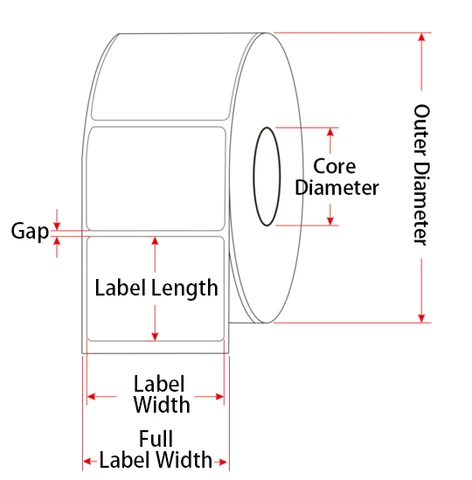
The repeat is the machine-direction pitch, including the gap. Usable running length excludes separately allowed setup and end waste. Account for expected rejects without counting the same loss twice. A simplified area-utilization estimate may help early budgeting, but it does not replace the press layout.
A quote-comparison checklist
Before choosing a supplier, put the following information beside each quote:
- Construction: exact facestock, adhesive and liner, or a clearly identified alternative awaiting approval.
- Original price: preserve the quoted number, currency and unit. Do not overwrite it with the converted figure.
- Quantity and format: width, material length, roll count and agreed billed area.
- Normalized price: currency per m², using full-precision calculations.
- Included charges: identify slitting, packing and other charges already included so they are not added twice.
- Delivered-cost basis: compare the same destination and the same included transport and destination costs. Mark unconfirmed items as unconfirmed, not zero.
- Usable output: check press compatibility, layout, trim and the basis for setup and reject allowances.
- Commercial terms: quantity minimums, quote validity, payment terms, tolerances and confirmed availability.
For a delivered-cost comparison, divide the sum of the material invoice and the additional non-duplicated costs you are comparing by the corresponding purchased area. Keep this metric separate from cost per accepted label; their denominators answer different questions.
If the construction is not yet settled, review the sample, MOQ and lead-time guide before treating a price comparison as a buying decision.
Questions about MSF and roll pricing
Is MSF the same as MSI?
No. MSF means 1,000 square feet; MSI means 1,000 square inches. One MSF equals 144 MSI. One MSI equals 0.64516 m². For a price quoted per MSI, divide by 0.64516 to obtain the price per m². Confirm the abbreviation rather than assuming a single-letter difference is a typo. Case Paper's unit explanation.
How many linear meters are in one MSF?
There is no fixed answer without a width. Divide 92.90304 m² by the roll width in meters. At a hypothetical width of 0.330 m, one MSF is approximately 281.52436 linear meters.
Can I compare a price per kilogram with a price per square meter?
Only when the mass basis is clear. If the price is per net kilogram of the complete laminate and its total basis weight is known, multiply the price per kilogram by the laminate's basis weight in g/m², then divide by 1,000. A facestock-only basis weight is not sufficient for the full construction. Check whether cores and packaging are excluded from the billed mass.
Does a lower price per square meter mean a cheaper finished label?
Not necessarily. Material suitability, layout, setup losses, rejects and other converting costs can change the cost of accepted labels. Compare the normalized stock price first, then compare the job using the same output and acceptance requirements.
Ask for a quote with the comparison basis stated
Send the material construction or application, print method, required roll width and length, order volume and destination. State the price unit and currency you want to use for comparison, and ask which charges are included.
Sources and calculation notes
- NIST, Guide to the SI, Appendix B.8: international-foot area conversion and square-inch conversion.
- Case Paper, MSI/MSF Calculator: paper-industry unit definitions and the relationship between MSI and MSF.
- All quote prices, widths, lengths and output quantities used in worked examples were selected for this tutorial. They are not commercial offers, company capabilities, independent market observations or experimental results. Calculations assume the conditions stated beside each example.