
How is synthetic paper different from ordinary paper label facestock?
Synthetic paper differs from ordinary paper label facestock in its base material. Paper is a web of cellulose fibers, so it absorbs water and tears along the fiber. AllinLabel PP synthetic paper is a polypropylene face with a matte, paper-like surface. It prints and writes like paper but does not soak up water and resists tearing.
| Criterion | Paper label facestock | AllinLabel PP synthetic paper |
|---|---|---|
| Base material | Cellulose fiber | Polypropylene, matte paper-like finish |
| Water | Absorbs water; can wrinkle or tear when wet | Waterproof face |
| Tear | Tears along the fiber | Tear-resistant (a material description, not a guarantee) |
| Print and writing | Prints like paper; takes a pen | Prints like paper; matte surface is writable |
| Main limit | Wet or heavily handled labels | Printed image, adhesive and UV exposure still need their own checks |
Sources: data sheet §1 and §3; product page.
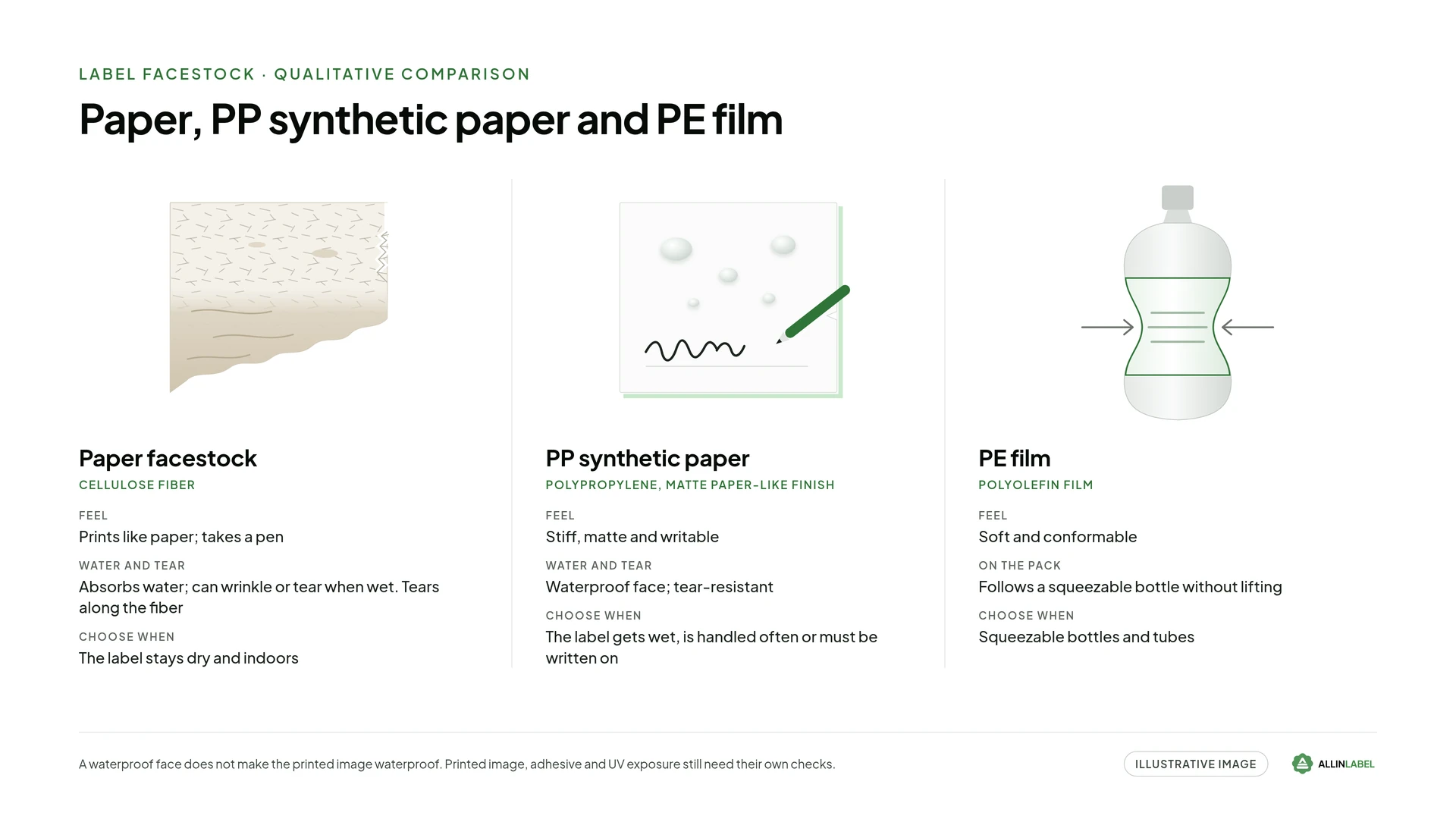
Choose paper facestock when the label stays dry and indoors; choose PP synthetic paper when the label gets wet, is handled often or must be written on. For the wider choice, see paper vs film label materials.
What is inside a PP synthetic paper label construction?
A PP synthetic paper label construction has three layers: the synthetic paper face, a pressure-sensitive adhesive and a silicone-coated release liner. In the AllinLabel standard construction AL-PPS-100-P-GL, a 100 µm white PP synthetic paper face carries a permanent water-based acrylic adhesive on a white glassine liner. The table shows published typical values.
| Layer or property | Typical value | Test method |
|---|---|---|
| Face: PP synthetic paper, white, matte | 100 µm (range 80–120 µm); 95 g/m² | ISO 534; ISO 536 |
| Adhesive: permanent acrylic, water-based | Coat weight 20 g/m² | — |
| Liner: white glassine, silicone-coated | 55 µm; 62 g/m² | ISO 534; ISO 536 |
| Peel adhesion, 180°, steel, 24 h | 11.0 N/25 mm | FINAT FTM 1 |
| Loop tack, stainless steel | 9.5 N/25 mm | FINAT FTM 9 |
| Minimum application temperature | +5 °C | — |
| Service temperature range | −20 °C to +80 °C | — |
Source: PP synthetic paper technical data sheet (PDF), version 1.0, issued 2026-08-04, §2–5. These are laboratory typical values, not a specification; test on your own containers.
How does synthetic paper compare with PE film?
PP synthetic paper and PE film are both polyolefin label faces, but they behave differently on the pack. PP synthetic paper is stiff, matte and writable, so it stays flat on rigid packs and dispenses easily. PE film is soft and conformable, so it follows a squeezable bottle without lifting.
Choose PP synthetic paper for rigid packs, drums, crates and tags; choose PE film for squeezable bottles and tubes. See the PP synthetic paper vs PE film comparison.
When is synthetic paper used for labels?
Synthetic paper is used for labels and tags that must keep a paper look after moisture, handling or tearing. The AllinLabel PP synthetic paper data sheet lists durable tags and swing tickets, outdoor and garden labels, and manuals, maps and menus. The product page adds product, horticultural and equipment identification labels.
Synthetic paper is a poor fit for:
- Squeezable containers: start with PE film.
- Direct thermal printing: PP synthetic paper has no thermal coating.
- Untested outdoor or chemical exposure: water resistance does not establish UV durability.
- Application below +5 °C with the standard adhesive (typical value).
Is thermal synthetic the same as synthetic paper?
No. Thermal synthetic label material is a thermal-printable film face, not a paper-like synthetic paper. The AllinLabel standard thermal synthetic construction AL-TS-50-P-GL uses a 50 µm PET film face (typical value, ISO 534, data sheet issued 2026-08-04). It is available for both direct thermal and thermal transfer printing.
Choose thermal synthetic for on-demand barcodes in wet or cold settings; choose PP synthetic paper for press-printed, writable labels. See thermal synthetic label material.
How should converters specify PP synthetic paper?
Converters should specify PP synthetic paper by the job, not by the material name alone. Send the press or printer model, ink and varnish, the container surface, how the label gets wet, and any chemical or outdoor exposure. Add the roll width, length and core. AllinLabel then matches face, adhesive and liner as one construction.
The data sheet lists UV flexo, water-based and solvent flexo, offset, screen, UV inkjet, and HP Indigo with a compatible primer. TT-coated grades take thermal transfer with a resin ribbon. Pre-test inks before production, and do not assume a grade suits laser printing. Confirm the adhesive and liner combination for the grade. The data sheet lists 76 mm and 25 mm cores.
Selection details: PP synthetic paper label material. Short definition: label material glossary entry. Other faces: film label materials.
What do converters ask about synthetic paper?
This section answers two further questions that converters and packaging buyers may have when they first assess synthetic paper for labels. The first is whether PP synthetic paper is just white BOPP under another name. The second is whether AllinLabel supplies branded synthetic papers. Each short answer gives the AllinLabel position.
Is PP synthetic paper the same as white BOPP?
No. Both are polypropylene faces, but they are different grades. AllinLabel lists white BOPP at 50, 60, 70 and 80 µm, gloss or matte, for bottle and container labels. PP synthetic paper is thicker at 80–120 µm (data sheet typical values), matte, writable and stiffer. Compare on the white BOPP label material page.
Does AllinLabel supply branded synthetic papers?
AllinLabel does not supply branded synthetic papers. The grade AllinLabel publicly offers is PP synthetic paper, coated and supplied as self-adhesive label stock rolls. If your job names a branded film, send the specification to tech@allinlabel.com.
How do I request PP synthetic paper samples or a quote?
To request AllinLabel PP synthetic paper samples or a quote, send the print process, label size, container surface, exposure and roll specification through the quote form or to sales@allinlabel.com. Free samples; you cover freight. Generally 15–30 days, depending on the product. Technical questions go to tech@allinlabel.com.
Request a quote or free samplesAbout the author. Gavin Gao is Marketing Manager at AllinLabel (Wenzhou All-In Packaging Technology Co., Ltd., founded in 2016), which supplies self-adhesive label material rolls to converters and printers.